

What 2026 buying behaviour means for B2B sales
B2B buying behaviour has changed faster than most sales processes. Buyers are researching earlier, using more channels, involving more people and expecting sales to add context, not repeat what they’ve already found online.
#awks
A lot of sales teams are still working as if the buyer starts the journey when they book a call.
They don’t.
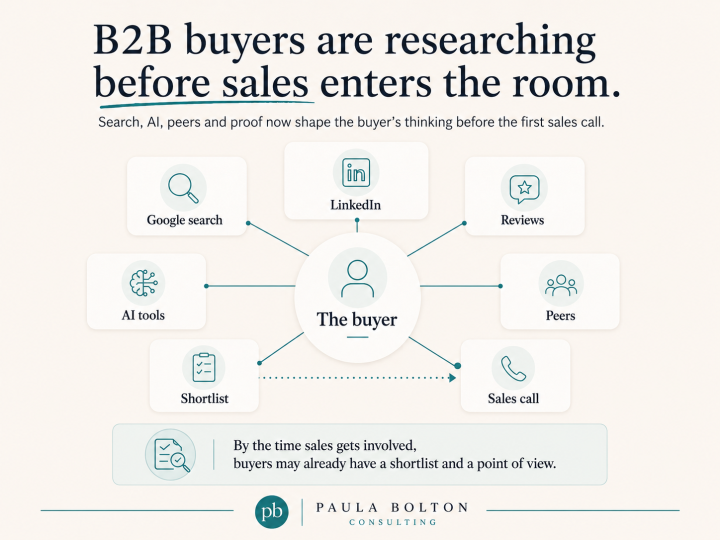
By the time someone speaks to sales, they may have searched Google, asked an AI tool, checked LinkedIn, looked at reviews, compared suppliers, spoken to peers, built an internal shortlist and formed a quiet opinion about who feels credible.
Then the salesperson turns up with a discovery script from 2014.
Strong start!…
This article looks at what current B2B buying behaviour means for your sales strategy, your messaging, your content and the way you convert opportunities.
B2B buyers want more control
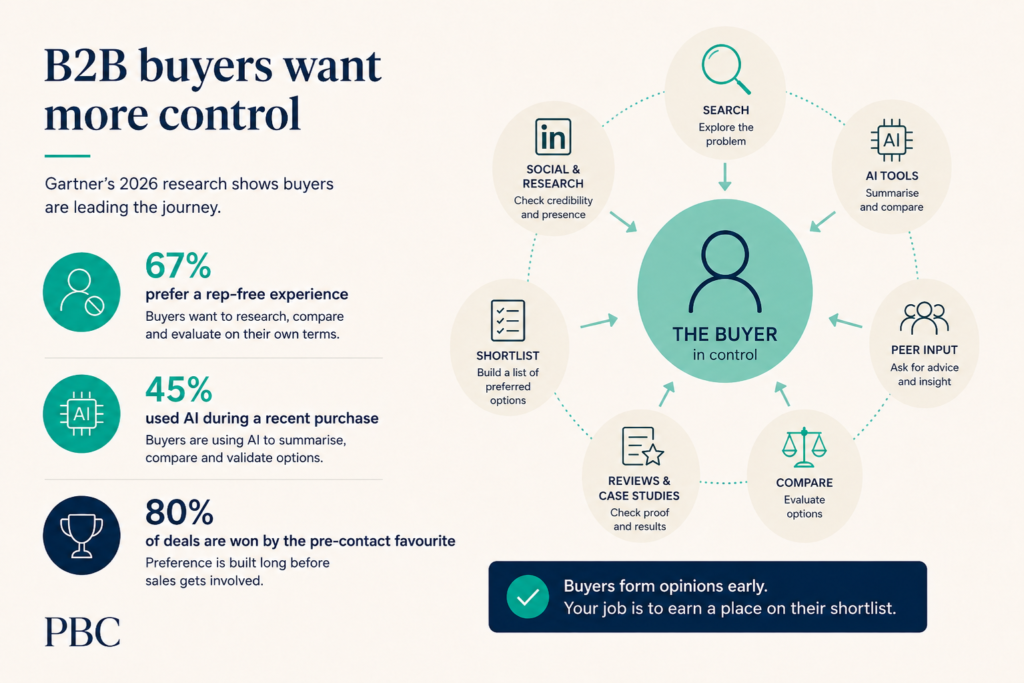
Gartner’s 2026 research found that 67% of B2B buyers prefer a rep-free experience, while 45% used AI during a recent purchase.
That does not mean salespeople are irrelevant.
It means buyers do not want to be pushed into a sales process before they are ready.
They want to research, compare, question and validate on their own terms. They want useful information before a call. They want clarity without pressure. They want to understand the problem before someone tries to sell them a solution.
For B2B sales teams, this changes the job.
Your sales process needs to support buyer-led research.
That means your website, articles, service pages, diagnostic tools, case studies and follow-up emails all need to help the buyer make sense of the decision.
If your content only says what you do, it is not doing enough.
Buyers are using more channels
McKinsey’s 2026 B2B research found that buyers use an average of ten channels across the purchasing journey and expect a seamless experience between them.
That matters because the buyer is not judging you from one touchpoint.
They may find you through Google, read an article, check your LinkedIn profile, look for proof, browse your service page, compare you with another provider and then ask an AI tool to summarise their options.
Cheerful little obstacle course.
If those touchpoints tell different stories, the buyer notices.
For example:
- your LinkedIn says you are sharp and commercially experienced
- your website says “bespoke solutions”
- your service page is vague
- your case studies are thin
- your follow-up says “just checking in”
- your proposal does not reflect the conversation
That creates friction.
Modern B2B buyer behaviour rewards consistency. Your message needs to hold together across every channel.
Buying groups are bigger and harder to influence
Forrester’s 2025 Buyers’ Journey Survey found that 73% of B2B purchases involve three or more departments, with an average of 13 internal stakeholders and nine external people involved in the purchase decision.
That explains why deals stall after a good call.
The person who likes you is rarely the only person who matters.
Finance wants numbers.
Operations wants implementation detail.
Leadership wants risk managed.
End users want to know whether this will make their life worse.
Procurement wants comparison.
Someone somewhere wants to “sense check” it, which is business language for slowing everything down.
Your sales process needs to help the visible buyer explain the decision internally.
That means giving them:
- a clear summary of the problem
- a business case for change
- proof that matches stakeholder concerns
- language they can reuse internally
- a realistic view of implementation
- a proposal that reflects their priorities
If your proposal only sells to the person on the call, it may fall apart when it reaches the people who were not there.
Buyers are choosing favourites earlier
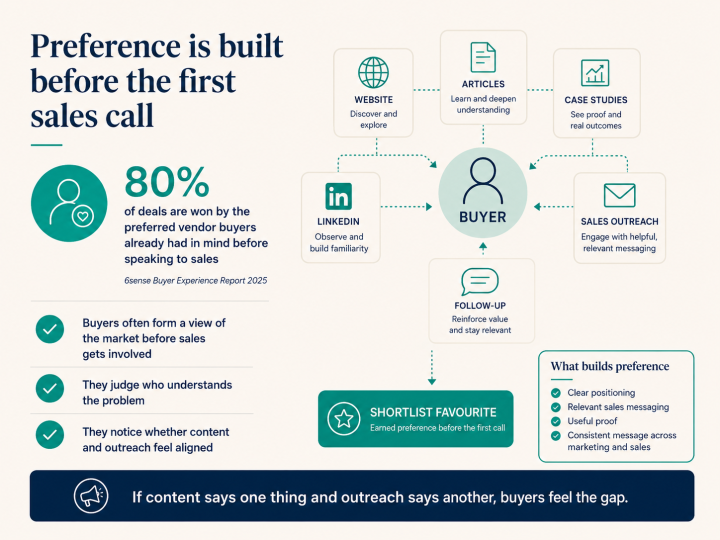
6sense’s 2025 Buyer Experience Report found that buyers often have a preferred vendor before they speak to sales, and that preferred vendor goes on to win around 80% of deals.
That creates a problem for any business relying on:
“We’ll explain it properly once we get them on a call.”
By then, the buyer may already have a working view of the market.
They may already think one supplier understands the problem better.
They may already trust one company’s content more.
They may already feel one sales message is sharper, clearer or more relevant.
They may already have ruled you out without ever telling you. Lovely.
Preference is not only built by marketing.
It is built by every signal the buyer sees before they make contact, including your website, articles, case studies, LinkedIn presence, outbound messaging, sales emails, call scripts, proposals and follow-up.
This is where sales and marketing need to be properly aligned.
Marketing should help buyers understand the problem before they speak to sales.
Sales should continue that same message when they reach out, qualify, run discovery and follow up.
If marketing is saying one thing and sales outreach sounds like a generic pitch from a different decade, the buyer feels the gap.
Your content might say:
“We understand how modern B2B buyers make decisions.”
Then your sales email says:
“Hope you’re well. Just wondering if you’d be open to a quick chat about how we help businesses grow?”
That is not alignment. That is two departments wearing the same badge and having completely different conversations.
Sales outreach needs the same clarity as your best content.
That means your sales messaging should show:
- the problem you believe the buyer is likely facing
- why that problem matters commercially
- what usually causes it
- what happens if it is ignored
- what makes your view credible
- what useful next step you are offering
For example, weak outreach says:
“We help B2B companies improve sales performance.”
Stronger outreach says:
“A lot of B2B teams don’t have a lead volume problem. They have a conversion problem sitting inside qualification, deal progression or follow-up. If that is showing up in your pipeline, it is usually worth diagnosing before adding more activity.”
The second message gives the buyer something to recognise.
That is what preference is built on.
Your articles should help buyers diagnose the problem.
Your service pages should make your offer easy to understand.
Your case studies should show proof, not just praise.
Your LinkedIn content should show judgement and experience.
Your sales outreach should continue the same commercial point of view.
Your follow-up should help the buyer think, not just remind them you exist.
The goal is simple.
When the buyer is still researching, your content should make them think:
“These people understand the problem.”
When sales reaches out, the buyer should think:
“This feels relevant to what we’re actually dealing with.”
That is how early preference becomes a real sales advantage.
AI is changing research, but not removing trust
AI is now part of the B2B buyer journey.
Gartner’s 2026 research found that 69% of B2B buyers prefer to validate AI-generated insights with sales reps. The same research also found that 70% prefer a completely digital, self-service buying experience.
That sounds contradictory.
It is not.
Buyers want independence when researching, but they still want human judgement when the decision carries risk.
They may use AI to summarise options, compare suppliers or understand the market. But they still need confidence that the answer applies to their situation.
This is where strong salespeople matter.
The role of sales is shifting from information delivery to interpretation.
A buyer does not need you to read your website out loud. They have already done that, or an AI tool has done it for them.
They need you to help them understand:
- what matters in their context
- where the real risk sits
- what options make sense
- what trade-offs they should consider
- what other businesses usually miss
- what decision path is sensible
That is buyer-led sales.
Useful, specific, commercially grounded.
This is the principle behind customer-centred selling: building the sales process around how the buyer researches, evaluates options, involves other people and makes the decision.
What this means for B2B sales teams
B2B buying behaviour has changed, so the sales process needs to work harder before, during and after the first conversation.
Buyers are researching earlier. They are comparing quietly. They are using AI, peer recommendations, LinkedIn, review sites and your website before they speak to sales.
That means your B2B sales strategy needs to cover more than lead generation and follow-up.
If you’re reviewing what that looks like in practice, these seven B2B sales strategies focus on the parts of the sales system that matter when revenue is inconsistent.
It needs to help buyers:
- understand the problem
- compare options
- trust your approach
- explain the decision internally
- feel confident enough to move forward
Help buyers diagnose the problem
Most buyers start by trying to understand what is wrong.
Your content should help them name the issue before they speak to sales.
Useful examples include:
- Why your B2B sales process isn’t converting
- Why your sales pipeline looks full but revenue is inconsistent
- How to tell whether the issue is positioning, pipeline or conversion
- What weak qualification does to forecast accuracy
This kind of content supports the B2B buyer journey because it gives buyers clearer thinking before the sales conversation starts.
Make the offer easy to understand
Buyers should not have to work hard to understand what you do.
A strong service page should explain:
- who the service is for
- what problem it solves
- what is included
- how the process works
- what the buyer gets at the end
- what proof supports the offer
- what the next step is
Clarity helps conversion. Vague service pages create doubt.
Align sales messaging with marketing
Your marketing may create the first impression, but sales usually has to carry it through.
If your website says one thing and your sales outreach sounds generic, the buyer notices.
Sales and marketing need the same commercial point of view.
That means your articles, service pages, LinkedIn posts, sales emails, discovery calls and follow-up should all speak to the same buyer problems.
For example, weak outreach says:
“We help B2B companies improve sales performance.”
Stronger outreach says:
“A lot of B2B teams do not have a lead volume problem. The issue often sits inside qualification, deal progression or follow-up. That usually needs diagnosing before adding more activity.”
The second version gives the buyer something specific to recognise.
Build proof for the people behind the buyer
The person on the call may like the idea, but they still need to take it back to others.
Different stakeholders need different proof.
A CEO may want commercial impact.
A sales leader may want adoption and accountability.
Finance may want risk and investment clarity.
Operations may want implementation detail.
Your case studies, proposals and follow-up should help the buyer answer those concerns internally.
Use discovery to improve the buyer’s thinking
Discovery should help the buyer understand what needs to happen next, not just help the seller collect information.
A useful question is:
“Once you’ve reviewed the options, what will you need to show internally for this to feel like the right decision?”
That question is simple, but it opens up the real buying process.
It helps uncover:
- who else needs to be involved
- what proof the buyer needs
- what risks need addressing
- what commercial case needs to be made
- what could slow the decision down
Good discovery should make the buyer clearer on the problem, the route forward and the internal conversation they need to have.
That improves the quality of the decision. It also makes your proposal and follow-up far more useful.
Help the buyer move the decision internally
Many B2B deals slow down because the buyer does not have enough material to explain the decision to others.
Give them something useful.
That might include:
- a short decision summary
- a simple business case
- a stakeholder-specific proof point
- an implementation overview
- a comparison guide
- a proposal linked to their priorities
This is buyer-led sales in practice. You are helping the buyer make progress inside their own business.
What to check in your own sales process
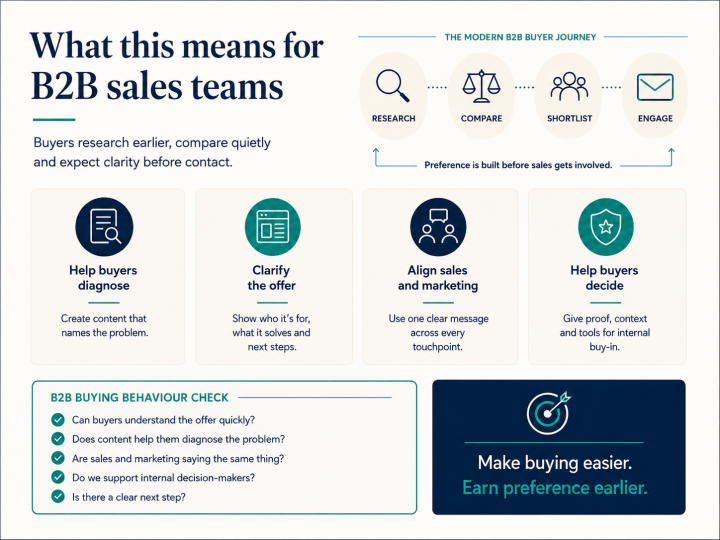
- Can buyers understand our offer before speaking to sales?
- Does our content help buyers diagnose the problem?
- Are our service pages answering real buyer questions?
- Do sales and marketing use the same commercial message?
- Are hidden stakeholders supported with proof?
- Does discovery uncover commercial impact?
- Do proposals help internal decision-making?
- Is there a practical next step before a sales call?
If you want to find out more about our strategic sales audit to get some help with this click here to view the Sales Audit Service
Final thought
B2B buying behaviour has changed.
Buyers want more control, useful information, credible proof and a sales process that helps them make a better decision.
They are already researching, comparing, asking AI, speaking to peers and forming opinions before your team enters the conversation.
Your job is to make that journey easier.