

The best B2B sales strategies now have less to do with pushing harder and more to do with helping buyers make sense of the decision in front of them.
That sounds simple.
Then you look at how a lot of teams still sell.
More outreach.
More follow-up.
More automation.
More “just checking in”.
More activity in the CRM that somehow still doesn’t turn into reliable revenue.
Lovely.
The problem is rarely effort on its own. More often, the sales strategy has been built around what the seller wants to do, rather than how the buyer actually buys.
B2B buyers are more informed, more cautious and more self-directed than they were a few years ago. They research before they speak to sales. They involve more people. They compare vendors quietly. They use AI, communities, peer recommendations and internal networks before anyone gets near a proposal.
So the old playbook needs tightening.
This article breaks down seven B2B sales strategies that are working now because they match how modern buyers research, decide and build trust.
Why most sales strategies stop working
Sales strategies usually fail for one of three reasons.
They chase activity instead of progress. They treat every buyer as if they’re ready to speak to sales. They ignore the buying group behind the person on the call.
Modern B2B buying does not move in a neat straight line. Gartner describes the B2B buying journey as a set of buying jobs, including problem identification, solution exploration, requirements building and supplier selection.
That matters because a sales strategy built only around “book the call, pitch the offer, send the proposal, chase the decision” misses most of the real decision-making.
The buyer is already asking:
- Is this problem serious enough to fix now?
- Who needs to be involved?
- Which vendors look credible?
- What will this cost internally?
- What happens if we pick the wrong supplier?
- Can we justify this to the people who control budget?
- Will this create more work than it solves?
The best B2B sales strategies help buyers answer those questions.
#1 Build preference before the sales call
The sale starts before the buyer books a meeting.
That’s awkward if your entire sales strategy relies on “let’s get them on a call and explain it properly”.
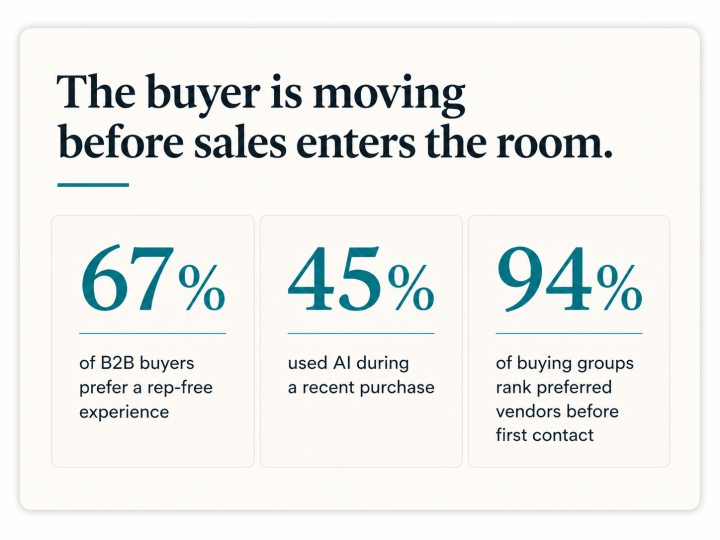
6sense’s 2025 Buyer Experience Report found that buyers purchase from one of the vendors on their Day One shortlist in 85% of cases, rising to 95% in 2025.
Another 6sense analysis found that buying groups place four out of five vendors they will evaluate on the shortlist from day one, buy from one of those four 95% of the time, and rank their preferred vendors before speaking to sellers 94% of the time.
That should make every B2B business slightly uncomfortable because buyers are forming opinions before your salesperson speaks to them.
They’re reading your website, comparing your positioning, checking whether your content sounds like it understands their world, and deciding whether you belong on the shortlist.
This is why your blog, service pages, case studies, resources and LinkedIn content are not “marketing bits”.
They are sales assets.
A useful B2B sales strategy now needs to create preference before demand becomes visible.
That means:
- writing content around the problems buyers are already trying to diagnose
- making your positioning clear enough to understand quickly
- publishing proof that matches real buying concerns
- using case studies that show the before, during and after
- making your offer easy to explain internally
- giving buyers practical resources before they speak to you
A buyer should be able to visit your site and think:
“They understand the problem.”
That is a much stronger starting point than:
“They seem very excited about their methodology.”
#2 Make outreach relevant enough to survive the delete key
Outreach still works.
Lazy outreach doesn’t.
Gartner’s 2025 sales research found that 73% of B2B buyers actively avoid suppliers who send irrelevant outreach.
So, if the strategy is still “send more emails until someone gives up and replies”, there’s your first problem.
Volume without relevance is just noise with a spreadsheet attached.
Good outreach now needs to show three things quickly:
- why this person
- why this problem
- why now
“Saw your LinkedIn post about leadership. Loved it.”
Especially when the post was from 2021 and about their dog.
Relevance means you understand the commercial situation the buyer may be dealing with.
For example, weak outreach says:
“We help B2B businesses improve sales performance.”
Better outreach says:
“You may already have enough leads in the pipeline. The issue is often that qualification is inconsistent, deals sit too long at proposal stage, and the forecast stops being useful.”
The second version gives the buyer something to recognise.
Useful outreach is specific without pretending you know everything. It opens a conversation around a real commercial problem.
Your outreach should be built around:
- trigger events
- industry pressures
- likely operational pain
- role-specific concerns
- proof of relevance
- one clear next step
If the buyer cannot see themselves in the message, the message is not ready.
#3 Sell to the buying group, not just the friendly contact
One person may book the call.
One person rarely carries the whole decision.
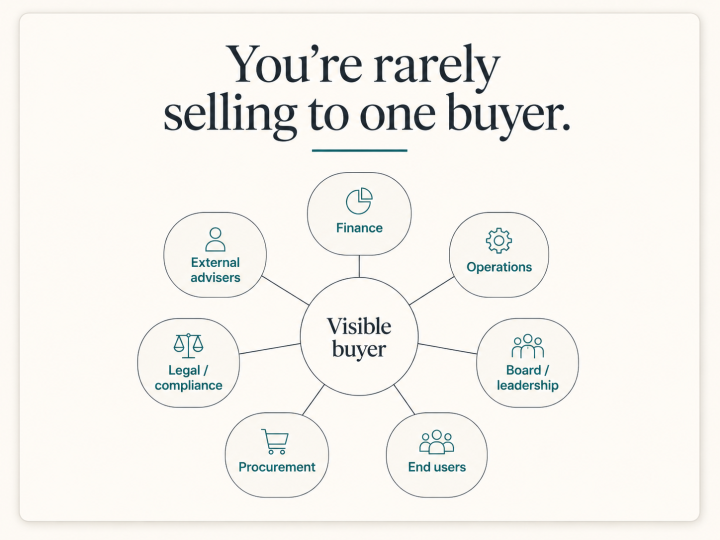
Forrester’s 2025 Buyers’ Journey Survey found that 73% of B2B purchases involve three or more departments, with an average of 13 people inside the buyer’s organisation and nine from outside involved in the purchase decision.
That is a lot of people with opinions.
Some will care about cost. Some will care about risk. Some will care about implementation. Some will care about compliance. Some will care because they enjoy making life difficult. Every buying group has one.
The mistake is selling only to the person who likes you.
That person may be your champion, but they still need to persuade everyone else. If they cannot explain the problem, the value, the risk, the proof and the next step internally, the deal becomes fragile.
Edelman and LinkedIn’s 2025 B2B Thought Leadership Impact Report found that hidden buyers actively discover, consume and evaluate thought leadership, and that these buyers can influence decisions even when they are less visible to sales.
Your sales strategy should help your main contact carry the decision through the business.
That means asking:
- Who else will influence this?
- What will they care about?
- What concerns are likely to come up?
- Who could block the decision?
- What proof will help them feel comfortable?
- What internal language will make this easier to explain?
Then build your follow-up and proposal around those answers. A good proposal gives the buyer the argument they need internally.
#4 Give buyers more than one route to engage
There is no single-channel buyer.
McKinsey’s 2026 Global B2B Pulse Survey found that buyers use an average of ten channels across the purchasing journey and expect seamless movement between them.
That does not mean you need to be everywhere, all the time, waving like a desperate man outside a conference centre.
It means your sales strategy should give buyers sensible ways to engage depending on where they are in the decision.
Some buyers want to read first.
Some want a diagnostic.
Some want pricing guidance.
Some want to compare options.
Some want to speak to a human once they have done their homework.
Some want enough information to decide whether a conversation is worth their time.
Your job is to remove friction without removing the human support that matters.
For a B2B consultancy or service business, that could mean:
- clear service pages
- strong comparison content
- practical diagnostic tools
- downloadable checklists
- short explainer videos
- useful case studies
- a direct enquiry route
- a clear booking option
- thoughtful follow-up after resource downloads
The point is not to add more channels for the sake of it.
The point is to meet buyers where they are in the decision.
If someone is still trying to diagnose the problem, give them content. If they know the problem and need a route forward, give them a service page. If they need internal support, give them a business case or checklist. If they’re ready to talk, make the next step obvious.
A good sales strategy gives buyers enough structure to move forward.#5 Use AI for sales intelligence, not lazy selling
AI is now part of both sides of the buying process.
Gartner’s 2026 sales research found that 67% of B2B buyers prefer a rep-free experience and 45% used AI during a recent purchase.
Gartner also found that 69% of B2B buyers prefer to validate AI-generated insights with sales reps, while 70% prefer a completely digital, self-service buying experience.
That is the useful tension.
Buyers want speed, independence and low-friction research. When the decision matters, they still want context, reassurance and judgement.
So the opportunity for sales teams is not to use AI to spray more mediocre messages into the market.
We’ve suffered enough.
The better use of AI is to improve sales preparation and decision quality.
Use AI to:
- research accounts before outreach
- summarise company context
- identify likely buying triggers
- draft sharper first versions of outreach
- analyse call notes
- spot common objections
- review CRM hygiene
- find patterns in lost deals
- prepare better follow-up
- create first-draft internal business cases
Then apply human judgement.
McKinsey’s 2025 work on gen AI in B2B sales highlights use cases across the seller journey, including next-best opportunity, account research, relationship mapping, stakeholder identification and personalised outreach.
AI can speed up research. It cannot replace commercial thinking.
The line is simple.
Use AI to become more relevant.
Avoid using AI to become louder.
#6 Turn discovery into commercial diagnosis
Discovery is where a lot of sales teams often lose the deal.
They ask a few questions, collect surface-level answers, then jump into solution mode.
A proper discovery conversation should feel like diagnosis.
The buyer should leave clearer than when they arrived. That is the standard.
Good sales discovery should uncover:
- what triggered the conversation
- what the buyer has already tried
- where the problem is showing up commercially
- what happens if nothing changes
- who else is affected
- what internal approval looks like
- what risks need managing
- what a good outcome would need to prove
This is especially important when the buyer has already done a lot of research. They may not need basic education. They may need help interpreting what they have found.
That is where the seller earns trust.
Poor discovery asks:
“What are your main challenges?”
Better discovery asks:
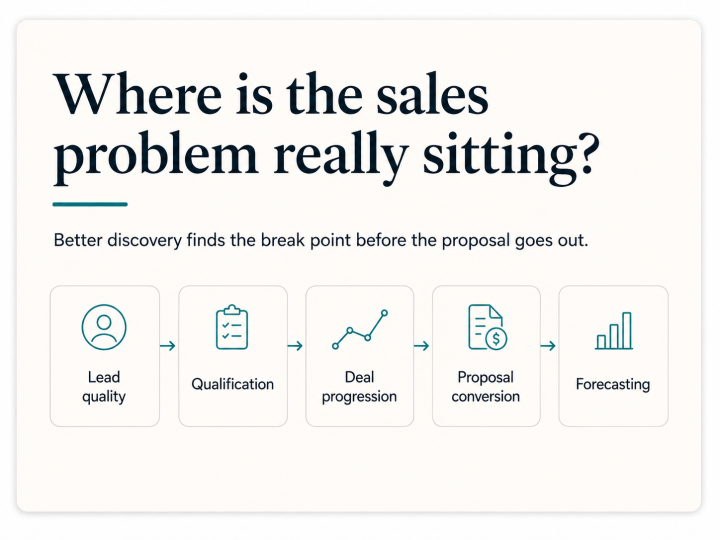
“You’ve said the pipeline looks healthy, but revenue is still inconsistent. Where does that start to break down: lead quality, qualification, deal progression, proposal conversion or forecasting?”
That question is more useful because it gives the buyer a diagnostic frame.
It also tells you something important.
If the buyer cannot locate the real issue, your sales process needs to help them.
That is the difference between taking an order and leading a commercial conversation.
#7 Build buyer enablement into every active deal
Buyer enablement is the practical work of helping buyers make the decision.
It is often the missing part of the sales process.
A buyer may like you. They may understand the value. They may even want to move forward. Then the deal goes into internal review and slowly disappears into the organisational fog.
That is not always a sales rejection.
Sometimes it is a buyer enablement failure.
The buyer did not have the right summary.
They could not explain the business case.
They did not have proof for finance.
The board had concerns nobody anticipated.
Operations wanted implementation detail.
The proposal was too generic.
The next step was unclear.
Buyer enablement gives your contact useful material to move the decision forward internally.
That might include:
- a decision summary
- a one-page business case
- a stakeholder-specific proof point
- a comparison guide
- an implementation overview
- a risk and mitigation summary
- a recap of agreed priorities
- a proposal linked directly to the buyer’s stated problem
This matters because modern B2B decisions are rarely private. Your buyer is often selling the decision internally long after your sales call has ended.
Your sales strategy should make that easier.
A useful follow-up after discovery might say:
“Based on what we discussed, the issue seems to be less about lead volume and more about pipeline quality, deal progression and inconsistent qualification. I’ve summarised the key points below so you can share them with the team.”
That is more useful than:
“Great to speak earlier. Let me know if you have any questions.”
The second one is technically a follow-up. Barely.
How to choose which sales strategy to fix first
You do not need to overhaul everything at once.
That is how businesses end up with 14 half-built initiatives and a sales team quietly ignoring all of them.
Start with the biggest commercial drag.
Ask:
- Are we getting enough of the right-fit enquiries?
- Are we converting enough of the right-fit enquiries?
- Are deals moving through the pipeline properly?
- Are proposals turning into decisions?
- Are forecasts close to reality?
- Are we relying too heavily on the founder or one senior seller?
- Are we losing deals because buyers cannot get internal approval?
- Are we using content and resources to create preference before the call?
If the issue is weak visibility, start with positioning, content and preference-building.
If the issue is poor conversion, start with discovery, qualification and proposals.
If the issue is pipeline chaos, start with CRM stages, deal reviews and forecasting rhythm.
If the issue is stalled deals, start with buying-group mapping and buyer enablement.
A good B2B sales strategy is not a list of fashionable tactics.
It is a set of choices that improves how your business creates, controls and converts revenue.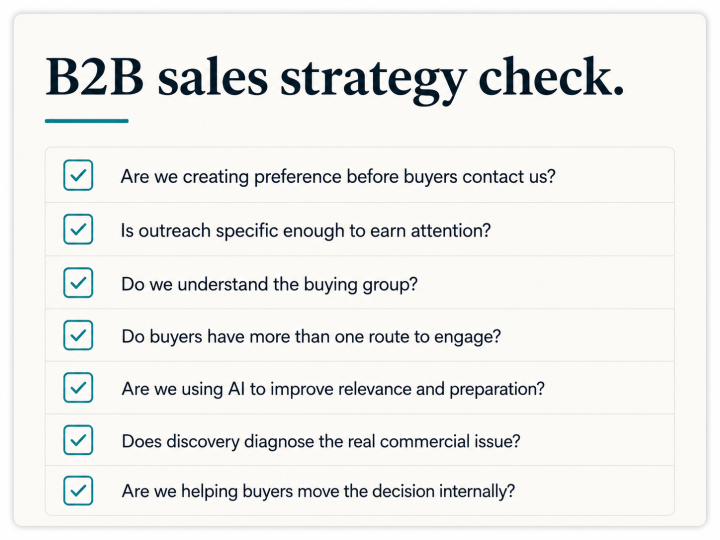
Common B2B sales strategy mistakes
- Chasing more leads when the real problem is conversion: More leads will not fix weak qualification, poor discovery or a proposal process that turns every deal into interpretive dance.
- Automating before the message is worth sending: Automation multiplies what already exists. If the message is generic, automation makes the problem bigger.
- Treating the CRM as admin: Your CRM should show how deals really move. If it does not reflect buyer stages, buying groups, next steps and risk, it is a reporting decoration.
- Using content only for awareness: Good content should help buyers diagnose, compare, justify and decide. It should support sales, not sit in a blog archive wondering what it did wrong.
- Letting proposals do too much heavy lifting: The proposal should confirm a well-run sales process. It should not rescue a vague one.
- Ignoring hidden buyers: Deals often stall with people you never met. Your sales material needs to support those people too.
B2B sales strategies FAQs
- What are B2B sales strategies?
B2B sales strategies are the structured choices a business makes to find, engage, qualify, progress and convert business buyers. Strong strategies cover positioning, outreach, discovery, pipeline management, buying-group support, proposals and follow-up.
- What is the best B2B sales strategy right now?
The strongest B2B sales strategy is buyer-led. That means building your sales process around how buyers research, compare options, involve stakeholders and make decisions. For many businesses, the biggest gains come from improving discovery, pipeline quality and buyer enablement.
- How has B2B sales changed?
B2B buyers now do more research before speaking to sales. They use more channels, involve more stakeholders and often arrive with preferred vendors already in mind. Sales teams need to create trust and preference earlier in the buying journey.
- Is cold outreach still worth doing?
Yes, but only when it is relevant. Generic outreach is easier to ignore than ever. Strong outreach is specific, problem-led and grounded in the buyer’s likely commercial context.
- How can AI help B2B sales?
AI can help with account research, call summaries, CRM analysis, stakeholder mapping, outreach drafts and opportunity prioritisation. It works best when it improves seller preparation and relevance. It works badly when it creates more generic activity.
- How do I know which sales strategy to fix first?
Look at where revenue is leaking. If you have weak enquiry quality, review positioning. If deals stall, review discovery, buying-group mapping and buyer enablement. If forecasts are unreliable, review CRM stages and deal review rhythm.
Final thought
The best B2B sales strategies now are sharper, more specific and more useful to the buyer.
They help buyers understand the problem, trust the route forward and build enough confidence to make a decision internally.
That means your sales strategy needs to do more than generate activity.
It needs to create preference before the call, make outreach worth reading, support the buying group, use AI intelligently, improve discovery and help buyers move through the decision with less friction.
If your current sales activity is high but revenue is still inconsistent, the issue may not be motivation.
It may be the system.