

How B2B content builds buyer confidence before sales speaks
Most B2B content is judged by traffic, leads and downloads.
That misses part of the job of B2B content marketing.
Before a buyer books a call, they are already deciding whether you understand the problem, whether your approach feels credible and whether choosing you would be easy to defend internally.
Recent 6sense research involving nearly 4,000 B2B buyers found that 94% of buying groups had ranked their shortlist before speaking to sellers. The vendor preferred before first contact went on to win 77% of the time.
Your first sales call is rarely the first impression. It is usually where the buyer checks whether the person matches the confidence created by the content.
Across the B2B buyer journey, a strong B2B content marketing strategy helps that confidence form earlier.
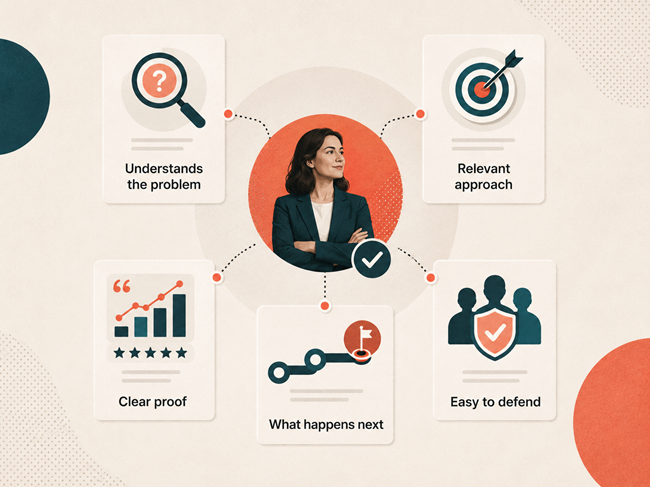
What buyer confidence actually looks like
- Do these people understand our problem?
- Is their approach relevant to a business like ours?
- Can they prove they know what they are doing?
- What will happen if we choose them?
- Can I explain and defend this decision internally?
Weak content leaves those questions open. The buyer has to work harder, fill in gaps and take more perceived risk.
Useful B2B content reduces that work. It gives the buyer clearer language, evidence and a sensible route forward.
Why generic B2B content fails to build trust
A polished article can still do very little.
The usual problem is that it describes the seller rather than helping the buyer make a decision:
- We are passionate about results.
- We provide tailored solutions.
- We have years of combined experience.
None of this helps a buyer judge fit, method or risk.
Replace broad claims with explanations, examples and evidence. Instead of saying, “We improve sales performance”, explain where performance usually breaks down, what evidence you review and what changes when the problem is fixed.
This is also why B2B thought leadership works when it contains a real point of view. LinkedIn and Edelman found that nearly three-quarters of decision-makers see thought leadership as a more trustworthy way to assess a company’s capabilities than traditional product or marketing materials.
Buyers want to see how you think before they agree to a conversation.
Five types of content that build buyer confidence
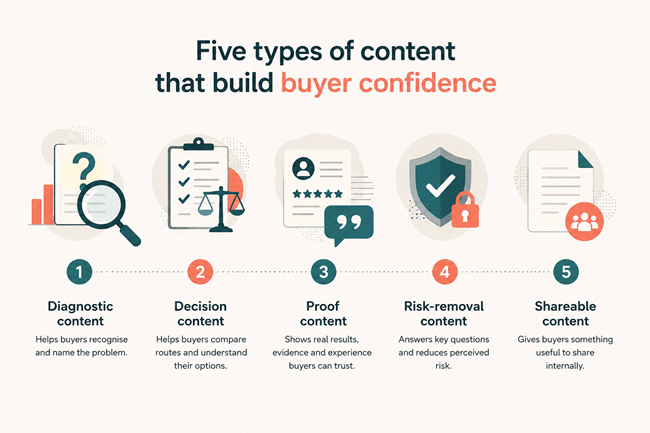
1. Diagnostic content
Diagnostic content helps buyers recognise and name the problem.
Useful topics include:
- why a healthy-looking pipeline doesn’t convert;
- how to tell whether the problem is leads, positioning or conversion;
- what weak qualification looks like in CRM data.
Recognition creates relevance. The buyer sees their situation in your explanation.
2. Decision content
Once buyers understand the problem, they need help comparing routes.
Explain when to use an audit, consultancy, training or fractional support. Cover what each option solves, the trade-offs and what needs to be in place first.
A buyer who understands the choices is more likely to trust the supplier willing to explain them properly.
For more on how different research routes shape buyer expectations, read B2B buyer research: why buyers rule you out early.
3. Proof content
Testimonials help, but “great to work with” only gets you so far.
Stronger proof includes:
- a before-and-after commercial measure;
- a real commercial problem;
- anonymised findings;
- a method shown in practice;
- an honest account of what changed.
Proof becomes more believable when it is precise enough to be checked.
4. Risk-removal content
B2B buyers are often deciding whether the change will create more problems than it solves.
Answer the questions they may not ask immediately:
- What happens first?
- Who needs to be involved?
- What data or access is required?
- How disruptive is implementation?
- What will the buyer receive?
- How will progress be measured?
FAQs, process pages and implementation guides reduce uncertainty before sales has to handle it live.
5. Content buyers can share internally
Your reader may like your approach and still be unable to move the decision forward.
LinkedIn’s 2025 research found that more than 40% of B2B deals stall because people inside the buying group aren’t aligned.
Create material your contact can use internally, such as:
- a one-page decision summary;
- an implementation outline;
- a business-case template;
- a stakeholder checklist;
- a relevant case study.
Good content gives your buyer something useful to take into the meeting you’ll never attend.
Build content from sales evidence
The best content ideas are often already sitting in sales calls, CRM notes, proposals, objections and lost opportunities.
In a previous group sales leadership role, I reviewed more than 3,000 outbound calls and analysed 1,040 lost opportunities across 12 products, 55 CRM users and 17 loss reasons.
That work produced a clear picture of where performance was breaking down. It exposed patterns in targeting, qualification, buyer objections, CRM usage and the points where opportunities lost momentum.
The value came from connecting the numbers with the context behind them. Call data showed what was happening. CRM records, loss reasons and sales conversations helped explain why.
The same approach strengthens your B2B content strategy.
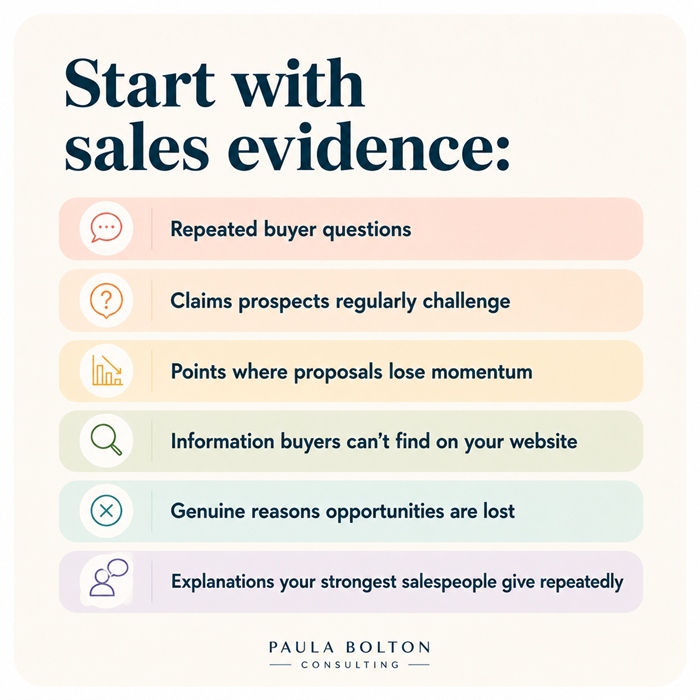
Start with:
- repeated buyer questions;
- claims prospects regularly challenge;
- points where proposals lose momentum;
- information buyers can’t find on your website;
- genuine reasons opportunities are lost;
- explanations your strongest salespeople give repeatedly.
These patterns give you content grounded in real buyer behaviour. They can be turned into articles, case studies, comparison guides, service-page content, FAQs and sales follow-up resources that answer the questions already affecting real opportunities.
For example, if buyers repeatedly ask how implementation works, create a clear process guide. If deals stall because stakeholders don’t understand the commercial case, produce content your main contact can share internally. If prospects keep questioning the same claim, add stronger evidence rather than polishing the wording again.
This is where sales and marketing alignment becomes practical. Sales identifies the questions, objections and gaps. Marketing turns that evidence into content buyers can find, understand and use.
The result is a B2B content strategy built around real buyer behaviour, rather than another list of topics chosen because they looked sensible in a spreadsheet.
Make content work in search and AI tools
The B2B buyer journey now moves across Google, LinkedIn, peer networks, review sites and AI tools.
6sense found that 94% of buyers used large language models during a recent purchase journey, often to compare, summarise and make sense of information. Their use of vendor content didn’t disappear. Buyers used AI alongside established sources rather than replacing them entirely.
Your content still needs to be worth finding and easy to interpret.
Use:
- clear headings based on buyer questions;
- direct answers near the start of each section;
- original examples and first-hand experience;
- evidence with sources and dates;
- consistent language across articles and service pages;
- internal links that help the reader continue their research;
- descriptive titles rather than clever but vague headlines.
Google applies the same core advice to traditional search and its AI search features: create helpful, reliable, people-first content.
Writing for buyers remains the safest SEO strategy. Convenient, really.
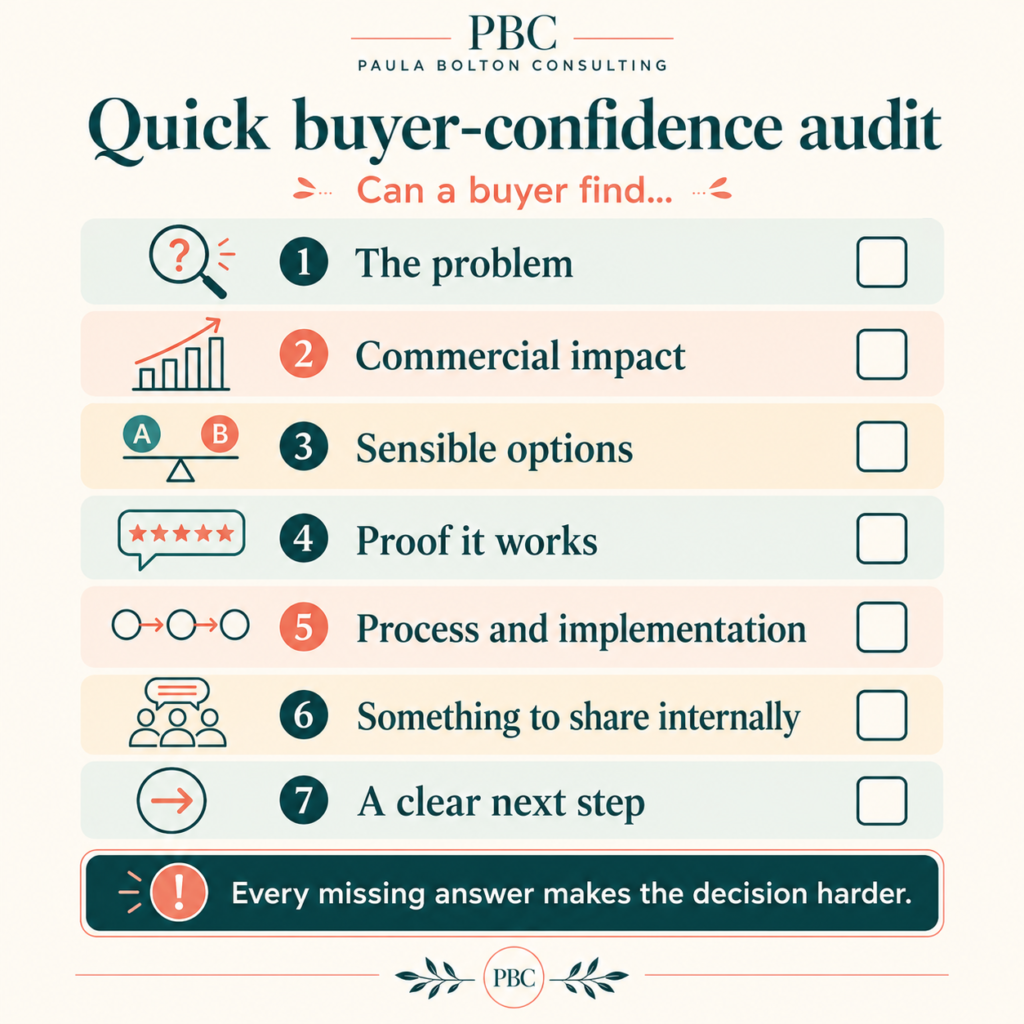
A quick buyer-confidence content audit
Choose one important service and ask whether a buyer can find:
- a clear explanation of the problem;
- evidence of its commercial impact;
- a comparison of the sensible options;
- proof that your approach works;
- answers about process and implementation;
- something to share with another decision-maker;
- a clear next step.
Every missing answer gives the buyer another reason to delay or choose the supplier who made the decision easier.
Make the first sales conversation feel like the next step
B2B content marketing should help buyers understand the problem, judge your expertise, reduce perceived risk and build enough confidence to move forward.
When the content, proof and sales conversation tell the same story, sales doesn’t have to begin from zero. The buyer arrives better informed, with fewer unanswered questions and a clearer reason to continue.
Customer-centred selling carries that same principle into the sales conversation, shaping discovery, follow-up and deal progression around how the buyer evaluates the decision and what they need to move forward.
A strategic sales audit reviews whether your positioning, content, website and sales process are helping buyers move forward or creating friction before the first call.
Start with the evidence, then fix what’s weakening buyer confidence.