

Customer-centred selling means building your sales process around how buyers think, research, hesitate, compare and decide.
That sounds obvious.
Then you look at most sales processes and realise they’re still built around the seller’s need to explain themselves.
The company.
The offer.
The features.
The platform.
The clever dashboard nobody woke up praying for.
Meanwhile, the buyer is trying to answer a completely different set of questions.
Can this solve the problem we’re actually dealing with?
Will this create more internal work?
Can I justify this to the board, finance, operations, or the person who usually appears at the end with “a few concerns”?
Do I trust these people to do what they say?
That is where customer-centred selling earns its keep.
It helps you move from product-led conversations to buyer-led sales conversations, where discovery, messaging, follow-up and proposals are shaped around how the customer is really making the decision.
What is customer-centred selling?
Customer-centred selling is a sales approach that puts the buyer’s priorities, pressures, decision process and internal context at the centre of the conversation.
It is sometimes called customer-centric selling, buyer-led sales or consultative selling. The names vary. The principle is simple.
You sell by understanding the buyer’s world before asking them to care about yours.
That means your sales process needs to uncover more than:
- what your product or service does
- what makes you different
- how much it costs
- when the buyer wants to start
A customer-centred sales process also needs to understand:
- what triggered the buyer to look for help now
- what they have already tried
- what happens if they delay the decision
- who else is involved
- what internal risks they need to manage
- what would make them hesitate
- what proof they need before they can move forward
Most buyers do not arrive as blank slates.
By the time they speak to you, they may already have researched your business, compared alternatives, asked peers, read reviews, checked your LinkedIn profile, looked at your website and quietly judged your proposal design. Delightful.
The sale does not start when the first call is booked.
It starts when the buyer begins making sense of the problem.
Why B2B buyers have changed
B2B buyers are more informed, more sceptical and more self-directed than they were a decade ago.
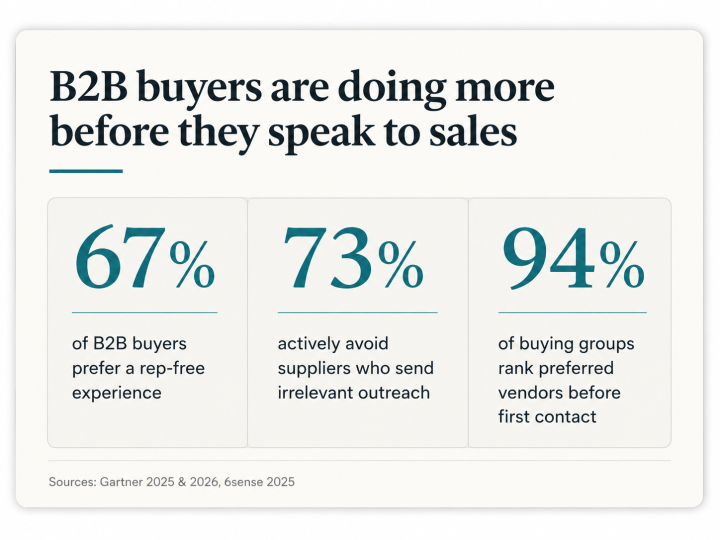
Gartner’s 2026 research found that 67% of B2B buyers prefer a rep-free experience. Its 2025 research also found that 73% actively avoid suppliers who send irrelevant outreach.
That does not mean buyers hate salespeople.
It means they hate poor selling.
They are avoiding:
- generic outreach
- feature-heavy pitches
- vague follow-ups
- discovery calls that feel like interrogation
- proposals that ignore what was actually discussed
- salespeople who rush the decision before earning trust
6sense’s 2025 Buyer Experience Report found that buyers are contacting sellers earlier than before, but decisions are still heavily shaped before first contact. The winning vendor is often already on the buyer’s initial shortlist.
That should make every B2B business slightly uncomfortable.
If your sales process only becomes useful after someone books a call, you may already be late.
Buyers start with problems, not features
Most buyers do not begin with a feature list.
They begin with a frustration.
The sales pipeline is full, but revenue is inconsistent.
The CRM says one thing and reality says something else.
The team is busy, but deals keep slipping.
The founder is still involved in every meaningful sales conversation.
Marketing is generating leads that sales quietly resents.
The proposal went out three weeks ago and everyone is pretending silence is “still positive”.
Features matter eventually.
Pain comes first.
A feature-led pitch sounds like this:
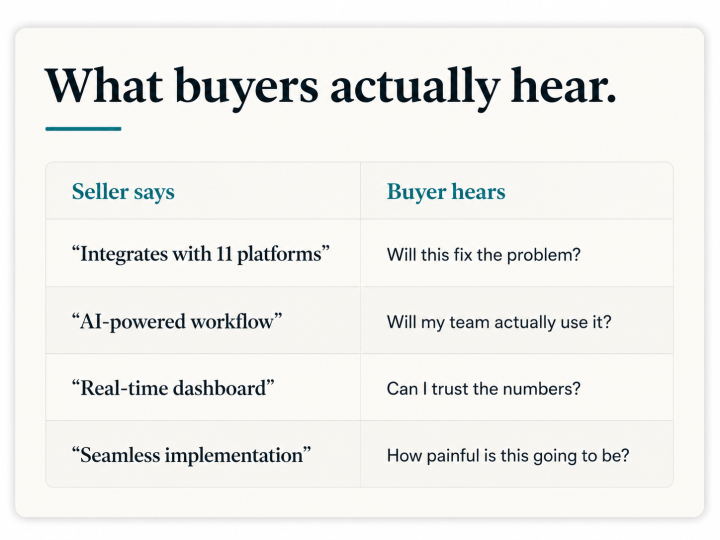
“Our platform integrates with 11 systems, includes AI-powered tagging, has automated workflows and gives you real-time visibility across the funnel.”
The buyer hears:
“Someone has brought jargon to the meeting. Excellent. Just what Tuesday needed.”
A customer-centred version sounds more like this:
“Most teams we speak to already have the tools. The issue is usually underneath them. Deals are updated late, qualification varies by person, and the forecast becomes more hopeful than useful. Is that close to what you’re seeing?”
That is a different conversation.
It shows you understand the commercial issue behind the tool conversation.
Discovery should feel like diagnosis
Poor discovery feels like someone filling in a CRM while maintaining eye contact.
A customer-centred discovery call feels like diagnosis.
The buyer should leave the conversation clearer than when they arrived, even if they do not buy from you. That is a high bar. Most sales calls are currently limbo dancing underneath it.
Good discovery does three things.
First, it uncovers the visible problem.
Second, it explores the commercial impact.
Third, it reveals the decision context.
Useful sales discovery questions include:
- What prompted you to look at this now?
- What have you already tried?
- Where is this showing up commercially?
- What happens if this stays the same for another six months?
- Who else is affected by this problem?
- What would a good outcome need to look like?
- What would make this difficult to approve internally?
- What would make you confident this is the right route?
- What are you comparing this against?
- Has anything similar been tried before?
The best discovery calls are built on structured curiosity.
You are trying to understand the buyer’s decision architecture: problem, pressure, risk, stakeholders, timing, alternatives and proof.
That is where the real sale usually sits.
Buyers want commercial relief
Nobody wants to buy a CRM clean-up project.
They want a pipeline they can trust.
Nobody wants a sales process review.
They want to know why deals keep stalling.
Nobody wants fractional sales leadership because it sounds impressive.
They want senior commercial control without hiring a full-time sales director before the business is ready.
Your product or service is the vehicle. The buyer cares about the relief.
In B2B sales, that relief might be:
- fewer missed forecasts
- cleaner qualification
- stronger conversion
- better sales meetings
- more useful CRM data
- shorter deal delays
- stronger board reporting
- fewer founder-led bottlenecks
- more confidence in the next quarter
This is why outcome-led messaging works better than feature-led messaging.
The buyer is not trying to admire your process. They are trying to fix something that has become expensive, irritating or risky.
For example:
Feature-led: “We provide fractional sales leadership, sales strategy and CRM support.”
Customer-centred: “We help B2B companies regain control of inconsistent sales performance by improving pipeline quality, deal progression, sales rhythm and accountability.”
The second version gives the buyer something to recognise.
The buying group is bigger than the person on the call
One of the easiest ways to lose a B2B sale is to sell only to the person who likes you.
Modern B2B buying decisions often involve visible buyers and hidden buyers. Your main contact may be interested, engaged and fully on board. Then finance, operations, procurement, legal, the board or an internal subject matter expert gets involved.
Suddenly, the deal slows down.
That does not always mean the buyer has changed their mind.
It often means they have run into internal friction.
Edelman and LinkedIn’s 2025 B2B thought leadership research found that hidden buyers are less likely to have direct interaction with sales. It also found that strong thought leadership can help reach and influence those hidden decision-makers.
This matters because your sales process needs to help your main contact carry the decision internally.
They may need:
- a clear summary of the problem
- a commercial case for change
- language they can reuse internally
- proof that addresses likely objections
- a sensible explanation of options
- an honest view of risks and trade-offs
- an implementation view that feels realistic
If your proposal only sells to the person you spoke to, it may fall apart the moment it reaches someone more cautious.
After a strong discovery call, ask:
“Who else will need to feel comfortable with this before you can make a decision?”
Then ask:
“What will they care about most?”
That second question is usually where the useful information appears.Trust is built through the sales process
Trust is not created by saying “trusted partner” on a slide.
Trust is built through behaviour.
Small things count:
- you send the recap when you said you would
- the recap reflects what the buyer actually said
- you remember the commercial pressure they mentioned
- you do not ignore awkward details
- you explain trade-offs clearly
- you follow up with something useful
- you make the next step obvious
- you do not vanish after the proposal goes out
This is basic sales hygiene.
Basic is where plenty of businesses leak revenue.
Buyers are looking for confidence.
Confidence that you understand the issue. Confidence that you can deliver. Confidence that choosing you will not make them look careless internally. Confidence that your team will behave after the deal exactly as they behaved before it.
That means the sales process itself becomes evidence.
If your sales process is messy, slow, vague or inconsistent, the buyer will make assumptions about delivery.
A customer-centred sales process makes trust visible.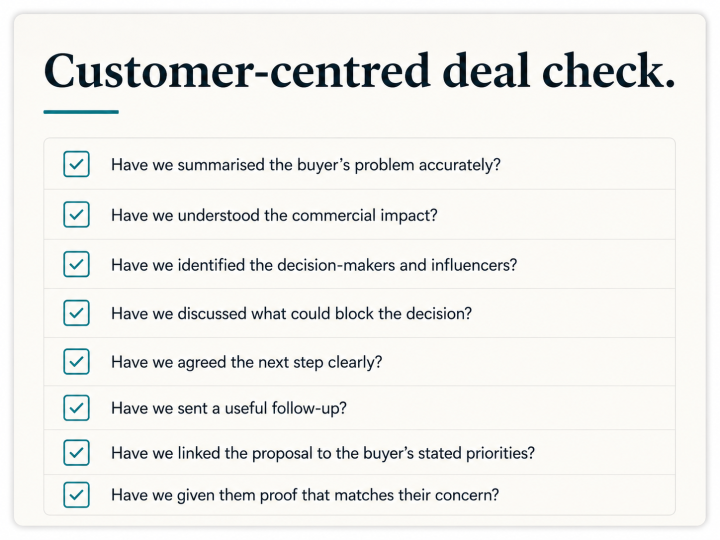
Customer-centred selling still needs commercial control
There is a lazy version of customer-centred selling where the seller becomes a polite passenger.
That does not work.
Buyers need space to think, but they also need structure. A strong sales process helps them make sense of the problem, understand their options and move through the decision with less friction.
Commercial control means:
- clear qualification
- useful questions
- agreed next steps
- honest recommendations
- decision criteria
- sensible timelines
- visible mutual commitment
A buyer-led sales conversation still needs a seller who can lead. The difference is that you are leading around the buyer’s decision, not around your preferred pitch.
How to make your sales process more customer-centred
Use this as a practical review of your current sales process.
Review your messaging Look at your homepage, service pages, outbound emails and proposals.
Ask:
- Are we leading with the buyer’s problem?
- Are we using language the buyer would actually use?
- Are we making the outcome clear?
- Are we relying too heavily on features, credentials or vague claims?
Tighten your discovery process Create a core discovery structure.
You do not need a script that makes everyone sound like they are trapped in a call centre. You need a consistent way to uncover problem, impact, context, stakeholders, timing, risk and decision process.
Build better follow-upA good follow-up email should include:
- what you heard
- what appears to be causing the issue
- why it matters commercially
- what options make sense
- what the next step is
- what you need from them
“Great to speak earlier” is not a follow-up strategy. It is a sentence looking for a job.
Create proof for each buyer concernDifferent buyers need different proof. A founder may want confidence that the work will create commercial traction. A sales leader may want evidence that the team will adopt the change. A finance lead may want risk, cost and payback. An operations lead may want implementation detail. A board may want governance, reporting and strategic fit.
Customer-centred selling means matching proof to concern.
Stop treating proposals like brochures
A proposal should not be a prettier version of your website.It should show:
- the problem as understood
- the impact of that problem
- the recommended route
- what is included
- what is not included
- the outcome expected
- the responsibilities on both sides
- the next decision required
The buyer should feel like the proposal was written for their situation. Radical, apparently.
Review your CRM stages
Your CRM should reflect how buyers buy, not how your team likes to report.
Useful stages might include:
- problem identified
- discovery completed
- decision process understood
- solution fit confirmed
- stakeholders mapped
- proposal sent
- internal review underway
- decision agreed
If your pipeline stages are vague, your forecast will be vague too.
Add a buyer enablement step
For more complex deals, give the buyer something they can use internally.That might be:
- a one-page business case
- an internal summary
- a decision checklist
- a comparison guide
- an implementation overview
- a risk and mitigation summary
This helps the person who likes you explain the decision to the people who have not met you.
Common customer-centred selling mistakes
Confusing friendliness with buyer understanding
Being warm helps.
It does not replace proper diagnosis.
You still need to understand the buyer’s problem, commercial pressure and decision process.
Asking discovery questions and ignoring the answers
If the proposal does not reflect the conversation, the buyer notices. Discovery should shape the recommendation.
Personalising the first line and calling it relevance
“Loved your recent LinkedIn post” does not count. Relevance means understanding the buyer’s context, not sprinkling personalisation on a generic pitch.
Letting the buyer control every next step
Buyers want autonomy. They also need useful guidance. A strong seller helps the buyer make progress without creating pressure.
Selling to one person and ignoring the buying group
Many deals are lost outside the sales call. If your internal champion cannot explain the value clearly, the deal becomes vulnerable.
Customer-centred selling FAQs
- What is customer-centred selling? Customer-centred selling is a B2B sales approach that builds the sales process around the buyer’s problems, priorities, decision criteria and internal buying process. It helps sellers move from product-led pitching to more useful, buyer-led sales conversations.
- Is customer-centred selling the same as consultative selling? They overlap. Consultative selling usually focuses on asking questions and advising the buyer. Customer-centred selling goes wider by looking at the full buyer experience, including messaging, discovery, stakeholder alignment, follow-up, proposals and post-sale trust.
- Why does customer-centred selling matter in B2B sales? B2B buyers now research more independently, involve more stakeholders and expect sales conversations to add context. Customer-centred selling helps your team become useful earlier in the decision process and more relevant when the buyer does engage.
- How do you make a sales process more customer-centred? Start by reviewing your messaging, discovery questions, CRM stages, proposal structure and follow-up process. Each part should help the buyer understand the problem, assess risk, compare options and make a confident decision.
- Does customer-centred selling mean avoiding sales targets? A customer-centred process still needs qualification, clear next steps, mutual commitment and strong deal control. The difference is that the process is built around how the buyer actually decides.
Final thought
Customer-centred selling works because it respects the reality of B2B buying.
Buyers are busy. They are cautious. They are researching before they speak to you. They are managing internal politics, competing priorities and the risk of making the wrong call.
The job of sales is to help them think clearly, trust the process and make a commercially sound decision.
If your current sales process is creating inconsistent conversion, stalled deals or weak follow-up, the issue may not be effort. It may be the way the buyer experience has been built.
A Strategic Sales Audit will show where the drag is coming from across your positioning, pipeline, discovery, proposals, CRM rhythm and conversion process.
Final thought
Customer-centred selling works because it respects the reality of B2B buying.
Buyers are busy. They are cautious. They are researching before they speak to you. They are managing internal politics, competing priorities and the risk of making the wrong call.
The job of sales is to help them think clearly, trust the process and make a commercially sound decision.
If your current sales process is creating inconsistent conversion, stalled deals or weak follow-up, the issue may not be effort. It may be the way the buyer experience has been built.
A Strategic Sales Audit will show where the drag is coming from across your positioning, pipeline, discovery, proposals, CRM rhythm and conversion process.