

A B2B sales process usually stops converting long before the proposal is sent.
The warning signs are there earlier: weak qualification, vague discovery, unclear next steps, hidden decision-makers and a pipeline that looks healthier than it really is.
That is the bit most businesses miss.
They look at the end of the process and ask:
“Why didn’t this deal close?”
Useful question. Late, but useful.
The better question is:
“Where did this deal start becoming unlikely?”
Because most conversion problems are built into the process before anyone says no.
The lead looked decent.
The first call went well.
The proposal was “with the team”.
The follow-up was polite.
The CRM still said 80% probability, bless it.
Then the deal stalled, vanished, went quiet, or chose another supplier who seemed to arrive already trusted.
This article breaks down why your B2B sales process isn’t converting, what the latest buyer research tells us, and how to fix the weak points that quietly damage sales conversion.
The uncomfortable truth about B2B sales conversion
A sales process can look healthy on the surface while deals fail to move forward.
The pipeline is full, but too many opportunities were never properly qualified. Calls happen, but the buyer’s decision process is still unclear. Proposals go out before there’s enough commitment. Next steps are vague, close dates keep moving and the same deals appear in forecast meetings week after week.
The activity is there. The progression isn’t.
If the same pattern shows up across multiple deals, it’s worth looking beyond individual opportunities at the wider B2B sales strategies shaping targeting, qualification, buyer progression and conversion.
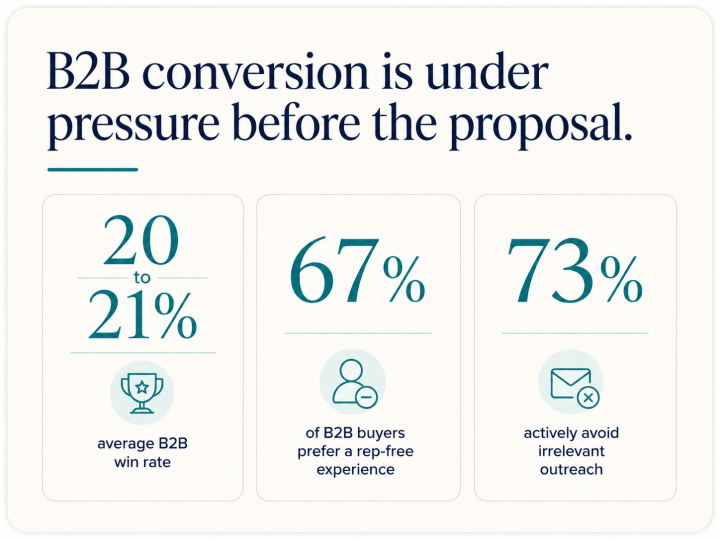
Benchmarks vary by industry, deal size and lead source, but recent B2B sales performance benchmark roundups put average B2B win rates around 20 to 21%, with stronger teams reaching 30% or more. Source: Gradient Works 2025 B2B sales performance benchmarks
That means many businesses are losing, delaying or losing control of most qualified opportunities.
Some of that is normal. You will not win every deal. Nor should you. Some opportunities are a poor fit and deserve to be politely released back into the wild.
The problem is when your sales process keeps creating the same failure patterns:
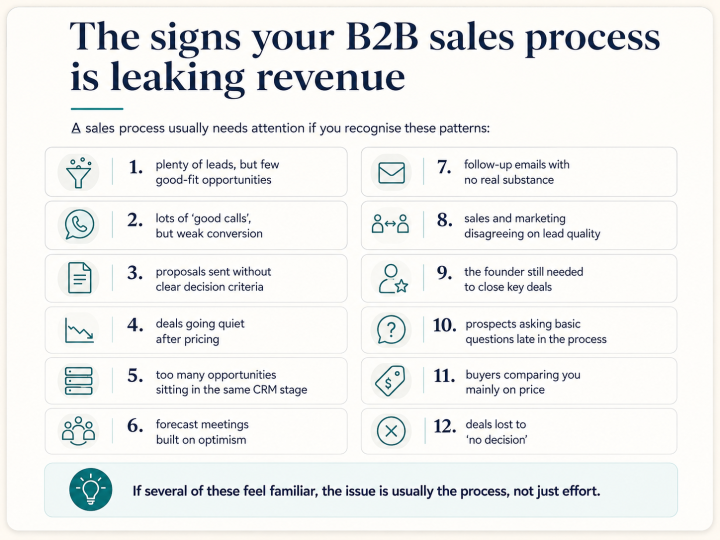
- leads look promising but do not convert
- discovery calls do not expose the real issue
- proposals are sent before decision criteria are clear
- deals sit in the pipeline with no meaningful next step
- forecast confidence is more emotional than factual
- buyers go quiet after seeming interested
- your team keeps blaming price, timing or “not ready”
- the founder or senior seller has to rescue too many deals
That is not a conversion problem at the end. That is a process problem throughout.
Why B2B buyers are harder to convert now
B2B buyers have changed faster than many sales processes.
Gartner’s 2026 sales research found that 67% of B2B buyers prefer a rep-free experience, while 45% used AI during a recent purchase.
Gartner’s 2025 research also found that 73% of B2B buyers actively avoid suppliers who send irrelevant outreach.
That does not mean buyers hate salespeople.
It means they are more selective about where sales people earn a place in the process.
They are doing more research before speaking to anyone. They are comparing options. They are asking AI tools to summarise vendors. They are looking at peer recommendations, case studies, LinkedIn activity, review sites and your website before anyone opens a calendar link.
6sense’s Buyer Experience Report found that 94% of buying groups rank preferred vendors before engaging with sellers.
That changes the job of your B2B sales process.
The first call is rarely the beginning of the buyer’s thinking. It is often a validation point.
If your sales process assumes the buyer is just starting, you may sound late, generic or oddly enthusiastic about things they have already researched.
Slightly awkward.
The reason your B2B sales process isn’t converting
Most sales conversion problems sit in one of seven places.
1. Your pipeline quality is weaker than it looks
A full pipeline is only useful if the opportunities inside it are real.
A lot of B2B sales processes confuse interest with intent.
Someone downloaded a guide.
Someone replied to an email.
Someone booked a call.
Someone said “sounds interesting”.
Useful signals, yes. Commercial certainty, no.
Weak pipeline quality usually shows up as:
- too many early-stage opportunities
- too many deals with vague next steps
- too many “checking in” follow-ups
- too many prospects who like the idea but do not act
- too many proposals sent to buyers who were never properly qualified
- too much time spent with people who cannot approve, influence or progress the decision
This is where sales pipeline conversion starts to break.
Your CRM may say “opportunity”. Reality may say “person with mild curiosity and a busy inbox”.
A better B2B sales process defines what qualifies as a real opportunity.
That should include:
- clear problem
- commercial impact
- buyer fit
- decision process
- urgency or trigger
- budget context
- stakeholder visibility
- agreed next step
If those are missing, it may still be a lead. It may even be a good conversation.
It is not yet a controlled opportunity.
2. Your discovery calls are too shallow
Discovery is where the conversion problem either gets exposed or quietly buried.
Many discovery calls stay too polite.
The buyer explains the surface problem. The salesperson nods. A few notes go into the CRM. Someone says “that makes sense”. The seller moves towards the solution because that feels productive.
Very civilised. Commercially dangerous.
A strong sales discovery process should uncover:
- what triggered the conversation now
- what the buyer has already tried
- where the problem is showing up commercially
- what happens if nothing changes
- who else is affected
- who else needs to approve or influence the decision
- what could block the project
- how the buyer will judge success
- what proof they need before moving forward
Poor discovery asks:
“What challenges are you facing?”
Better discovery asks:
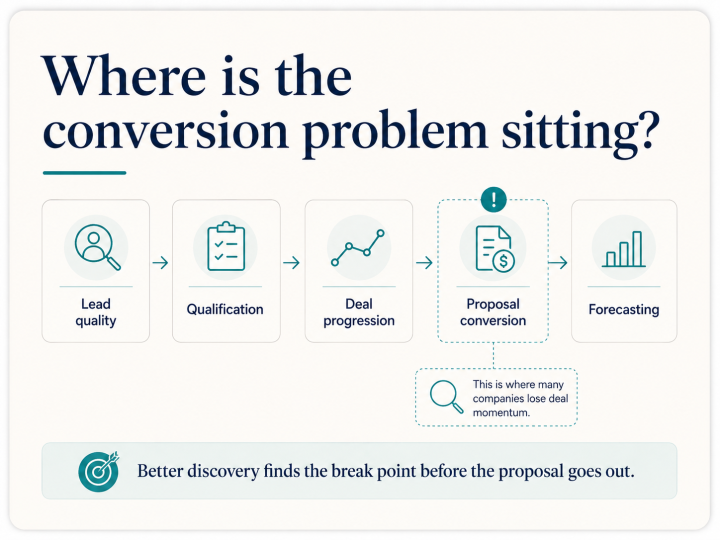
“You’ve said the pipeline looks busy, but revenue is inconsistent. Where is the break happening: lead quality, qualification, deal progression, proposal conversion or forecasting?”
That kind of question does two useful things.
It helps the buyer think more clearly.
It tells you where the sales process needs to go next.
Good discovery is not a friendly questionnaire. It is commercial diagnosis.
3. You are selling to one person when the decision belongs to a group
One person may book the call.
The decision usually has company.
Forrester’s 2025 Buyers’ Journey Survey found that 73% of B2B purchases involve three or more departments, with an average of 13 people inside the buyer’s organisation and nine from outside involved in the purchase decision.
That is not a buying journey. That is a committee with Wi-Fi.
If your B2B sales process focuses only on the person who likes you, your conversion rate will suffer.
The buyer on the call may understand the value.
Finance may want numbers.
Operations may want implementation detail.
The board may want risk managed.
End users may worry about adoption.
Procurement may want comparison.
Legal may appear near the end with excellent timing and several concerns.
A good sales process helps your main contact carry the decision internally.
Ask:
- Who else will influence this?
- What will they care about most?
- Who could slow this down?
- What concerns are likely to come up?
- What proof will help them feel comfortable?
- What will make this easier to explain internally?
Then build those answers into your follow-up, proposal and proof.
Many deals do not fail because your contact lost interest.
They fail because the wider buying group was never properly supported.
4. Your proposal is doing too much heavy lifting
A proposal should confirm a good sales process.
It should not rescue a vague one.
If the proposal is the first time the buyer sees the commercial case clearly explained, the process is already working too hard at the wrong stage.
Weak proposals usually contain:
- too much generic company information
- too many service descriptions
- too little buyer context
- vague outcomes
- no link to the commercial issue
- no proof matched to the buyer’s concern
- unclear next steps
- pricing without enough value framing
The buyer does not need a prettier version of your website.
They need a clear decision document.
A strong proposal should include:
- the problem as understood
- the commercial impact of that problem
- the buyer’s priorities
- the recommended route
- what is included
- what is not included
- evidence or proof
- responsibilities on both sides
- the decision required
- the next step
This is where B2B sales conversion often improves quickly because it becomes easier for the buyer to understand, trust and share.
5. Your follow-up is too passive
“Just checking in” has probably killed more B2B deals than most competitors.
It sounds harmless but it also gives the buyer no reason to respond.
Passive follow-up usually appears when the salesperson has lost control of the next step. The proposal has gone out. The buyer has gone quiet. The seller does not want to seem pushy, so they send a polite nudge and hope the universe takes an interest.
It rarely does.
A better follow-up should do one of four things:
- clarify the decision
- add useful context
- answer a likely concern
- help the buyer move the conversation internally
For example:
“Based on what we discussed, the main issue seems to be inconsistent qualification rather than lead volume. I’ve summarised the three points that may be useful to share with the wider team before our next conversation.”
That is useful.
“Any thoughts?” is not a strategy.
If your follow-up is weak, your sales process becomes dependent on the buyer doing the thinking, chasing and internal selling for you.
Some will, but most are busy.
6. Your sales stages do not match how buyers buy
Many CRM stages are built around seller activity.
Lead. Qualified. Demo. Proposal. Negotiation. Closed.
That may be easy to report on. It does not always show how close the buyer is to making a decision.
Buyer-led stages are more useful.
For example:
- problem recognised
- commercial impact understood
- solution options being compared
- stakeholders identified
- decision criteria confirmed
- proof reviewed
- internal approval underway
- next step agreed
- decision made
That gives you a better view of sales pipeline conversion because it reflects buyer progress.
A deal should not move forward just because a call happened.
It should move forward because the buyer’s decision has moved forward.
This is where many forecasts become fiction.
The CRM shows stage progression. The buyer is still stuck trying to work out whether the problem matters enough to fix.
Different things. Similar-looking dashboard.7. You are not creating enough trust before the buyer speaks to you
Modern B2B buyers often arrive with a point of view already formed.
McKinsey’s 2026 Global B2B Pulse research found that buyers use an average of ten channels across the purchasing journey.
That means your sales process is no longer confined to calls, emails and proposals.
Your website, articles, case studies, LinkedIn posts, resources and service pages are all part of the conversion journey.
If those assets are vague, generic or too internally focused, the buyer may never make it to sales.
This matters for B2B sales conversion because trust is being formed earlier.
Buyers want to see:
- that you understand their problem
- that your offer is clear
- that your proof is credible
- that your process feels sensible
- that your thinking is useful
- that your claims are not decorative nonsense
Your content should support the sales process before the buyer books a call.
That means writing articles, resources and service pages that help buyers diagnose the issue, understand their options and decide whether they trust your approach. If your content only explains what you do, it is underperforming.
The signs your B2B sales process is leaking revenue
How to fix a B2B sales process that isn’t converting
You do not need to rebuild everything in one heroic burst. That is how teams end up with a 47-slide sales playbook nobody opens.
Start with the biggest leak.
Step 1: Define what a qualified opportunity really means
Tighten the entry criteria for your pipeline.
A real opportunity should have:
- a clear problem
- commercial impact
- fit with your offer
- a decision process
- stakeholder visibility
- a reason to act
- an agreed next step
If those are missing, keep the lead in nurture or early qualification.
Do not let curiosity dress up as pipeline.
Step 2: Build a diagnostic discovery structure
Give your team a consistent discovery framework.
For example:
- Trigger: why now?
- Problem: what is happening?
- Impact: what is it costing?
- Attempts: what have they tried?
- Stakeholders: who is involved?
- Risk: what could block this?
- Criteria: how will they decide?
- Proof: what would build confidence?
- Next step: what happens next?
This keeps discovery useful without turning people into script-reading robots.
Step 3: Map the buying group early
Do this before the proposal.
Ask:
- Who else needs to be involved?
- Who owns budget?
- Who will use or feel the impact of this?
- Who usually raises concerns?
- Who signs off?
- What will each person care about?
Then tailor the proof.
Finance may need commercial impact. Operations may need implementation detail. The board may need risk and governance. End users may need adoption support. One proposal. Multiple concerns.
Step 4: Turn proposals into decision support
Rewrite your proposal around the buyer’s situation.
Use this structure:
- What we heard
- What appears to be causing the issue
- Why it matters commercially
- What we recommend
- What the work includes
- What the buyer needs to provide
- Proof or relevant examples
- Investment
- Next step
That structure helps the buyer share the proposal internally. Which is useful, because that is often where the deal is won or lost.
Step 5: Replace passive follow-up with useful follow-up
Every follow-up should earn its place.
Send:
- a short recap
- a useful comparison
- a decision summary
- a relevant case study
- a response to an objection
- a reminder of the agreed priority
- a clear next step
The buyer should never have to ask:
“Why have they sent me this?”
A good follow-up moves the decision forward.Step 6: Make your CRM reflect buyer progress
Review your CRM stages.
Ask whether each stage shows seller activity or buyer progress.
Better stages might include:
- problem identified
- commercial impact agreed
- decision criteria understood
- stakeholders mapped
- solution fit confirmed
- proof reviewed
- proposal under internal review
- decision date agreed
Then make sure every stage has exit criteria. A deal should only move forward when the buyer has moved forward.
Step 7: Create content that supports conversion
Your content should help buyers before they speak to you.
Useful conversion-supporting content includes:
- diagnostic articles
- comparison guides
- objection-handling articles
- case studies
- sales process checklists
- proposal review templates
- CRM audit templates
- buyer decision guides
This is especially important when buyers want more self-directed research. If they are going to research anyway, give them something useful to find.
Common B2B sales process mistakes
- Mistake 1: Treating more leads as the answer – More leads can make a broken process noisier. If your qualification, discovery and proposal process are weak, more leads will create more admin, more follow-up and more frustration.
- Mistake 2: Sending proposals too early – A proposal sent before the buyer’s decision process is understood becomes a brochure with pricing attached. Do the diagnostic work first.
- Mistake 3: Letting the buyer define the process alone – Buyers want control, but they also need structure. A good sales process helps them move through the decision without pressure.
- Mistake 4: Mistaking interest for intent – Interest sounds like: “That’s useful.” Intent sounds like: “We need to fix this, these people are involved, this is the decision process, and this is what we need to see next.” Very different.
- Mistake 5: Using the same proof for every buyer – Different stakeholders need different proof. Match the evidence to the concern.
- Mistake 6: Ignoring no decision losses – No decision is one of the most useful failure patterns. It often points to weak urgency, unclear value, missing stakeholders or poor internal decision support.
B2B sales process FAQs
What is a B2B sales process?
A B2B sales process is the structured path a business uses to identify, qualify, progress and convert business buyers. A strong process covers lead quality, discovery, stakeholder mapping, proposals, follow-up, CRM stages and deal review.
Why is my B2B sales process not converting?
Your B2B sales process may not be converting because the pipeline quality is weak, discovery is too shallow, decision-makers are missing, proposals are too generic, follow-up is passive or CRM stages do not reflect buyer progress.
What is a good B2B sales conversion rate?
B2B conversion rates vary by industry, lead source and deal complexity. Recent benchmark roundups put average B2B win rates around 20 to 21%, with stronger teams reaching 30% or more. The more useful question is where your own pipeline is leaking between lead, qualified opportunity, proposal and closed-won.
How do you improve B2B sales conversion?
Start by diagnosing the specific break point. Improve qualification, make discovery more commercial, map the buying group earlier, turn proposals into decision-support documents, replace passive follow-up and make CRM stages reflect buyer progress.
How do you know if the problem is lead quality or sales process?
If poor-fit prospects enter the pipeline, it is likely a lead quality or positioning issue. If good-fit prospects show interest but do not progress, it is more likely a sales process issue around discovery, stakeholder mapping, value framing, proposals or follow-up.
Final thought
If your B2B sales process isn’t converting, the answer is rarely “try harder”.
Effort matters, obviously. Nobody has ever accidentally followed up their way to a brilliant sales operation while doing absolutely nothing.
But most conversion problems are structural.
The pipeline is too loose.
Discovery is too shallow.
The buying group is hidden.
The proposal is too generic.
Follow-up is passive.
CRM stages are seller-led.
The buyer is not being helped to make the decision internally.
Fixing sales conversion starts with finding the real break point.
A Strategic Sales Audit will show where the drag is coming from across your positioning, pipeline, discovery, proposals, CRM rhythm and conversion process.