

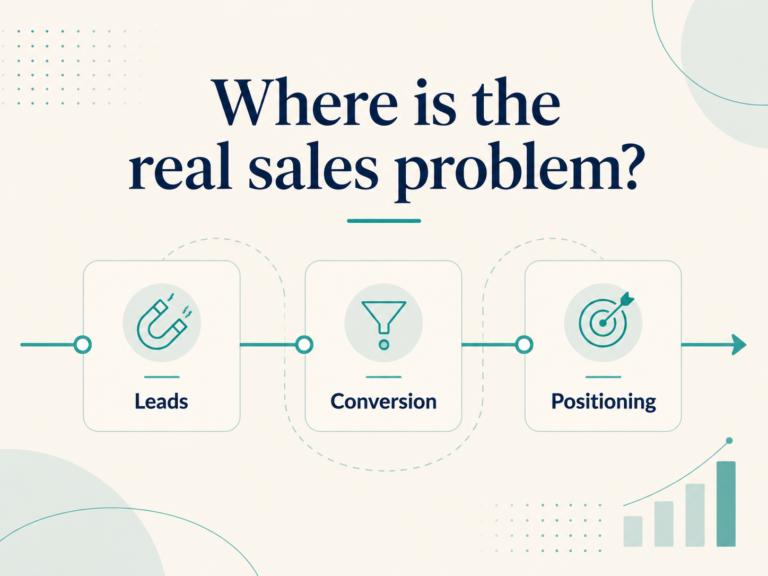
A sales problem is rarely as simple as “we need more leads”. Sometimes the issue is visibility. Sometimes it is conversion. Sometimes your positioning is not giving the buyer a clear enough reason to choose you.
The difficult bit is knowing which one you are actually dealing with.
Because from the inside, these problems often look the same.
- Revenue feels inconsistent.
- The pipeline looks unreliable.
- Sales meetings feel busy, but not enough is closing.
- Marketing says the leads are there.
- Sales says the leads are weak.
The boss says everyone needs to try harder, which is a very popular strategy in businesses that enjoy repeating the same month with different stationery.
Before you add more activity, more campaigns, more follow-up, more automation or another “quick sales push”, you need to diagnose the real issue. This article breaks down how to tell whether your sales problem is leads, conversion or positioning, and what to fix first.
Why sales problems are often misdiagnosed
Most businesses diagnose sales problems too late in the process.
They notice the symptoms:
- not enough good opportunities
- too many deals stalling
- proposals going quiet
- buyers comparing mainly on price
- inconsistent revenue
- weak forecast confidence
- too much dependency on one strong seller or the founder
Then they jump to the easiest explanation.
“We need more leads.”
Sometimes that is true.
Often, it is not.
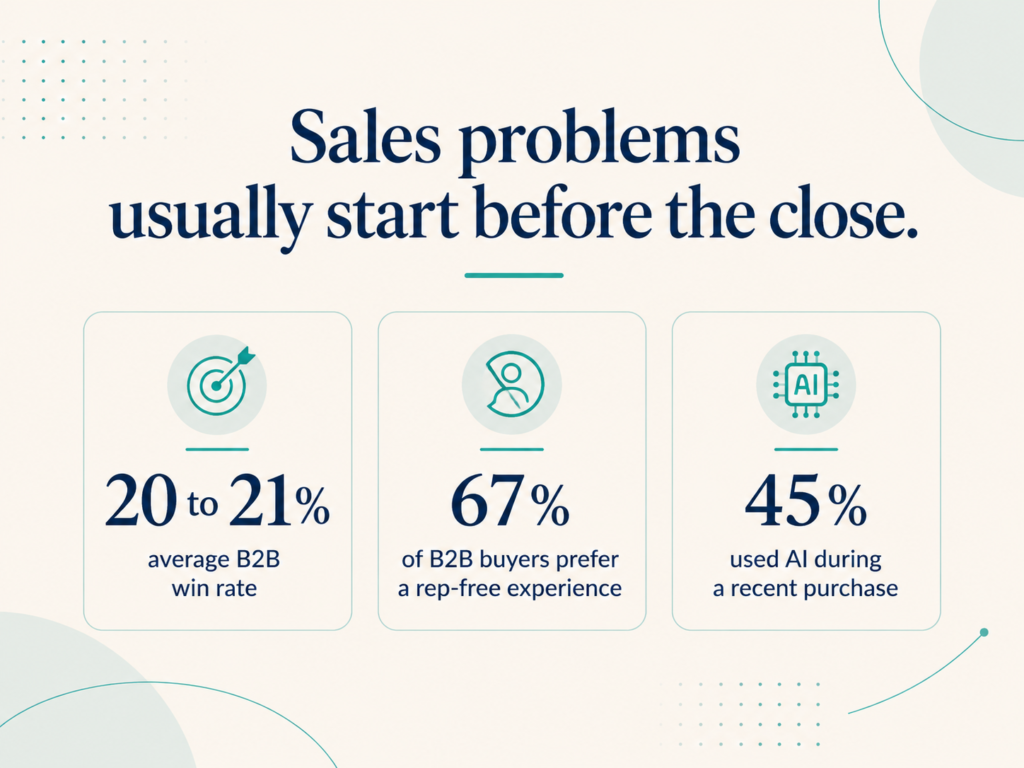
Recent B2B sales benchmark data shows how much variation exists across the funnel. Gradient Works’ 2025 B2B sales performance benchmarks put average B2B win rates around 20 to 21%, with top performers reaching 30% or more.
That means most B2B teams lose, delay or lose control of a large share of opportunities. The question is where the leakage starts.
Gartner’s 2026 research also found that 67% of B2B buyers prefer a rep-free experience, while 45% used AI during a recent purchase.
Buyers are researching earlier, involving more people and arriving with more context than before. A weak sales process, unclear positioning or poor buyer experience will show up faster.
So before you ask, “How do we get more leads?”, ask a better question:
“Where is the buyer losing confidence?”
The three sales problems that look alike
1. Lead problem
You do not have enough of the right people entering the pipeline.
This usually means the issue is visibility, demand, targeting, channel quality or audience fit.
2. Conversion problem
You have interest, conversations or proposals, but not enough deals are moving forward.
This usually means the issue is qualification, discovery, follow-up, proposal quality, stakeholder mapping or deal progression.
3. Positioning problem
The market does not clearly understand why you, why now or why this approach.
This usually means your message is too broad, too similar to competitors, too internally focused or not linked tightly enough to buyer pain.
These problems overlap.
That is what makes them irritating.
A positioning problem can look like a lead problem because the wrong people respond.
A conversion problem can look like a lead problem because sales says the leads are poor.
A lead problem can expose a positioning problem because nobody understands the offer quickly enough.
You need to separate the symptoms before you choose the fix.
Signs you have a lead problem
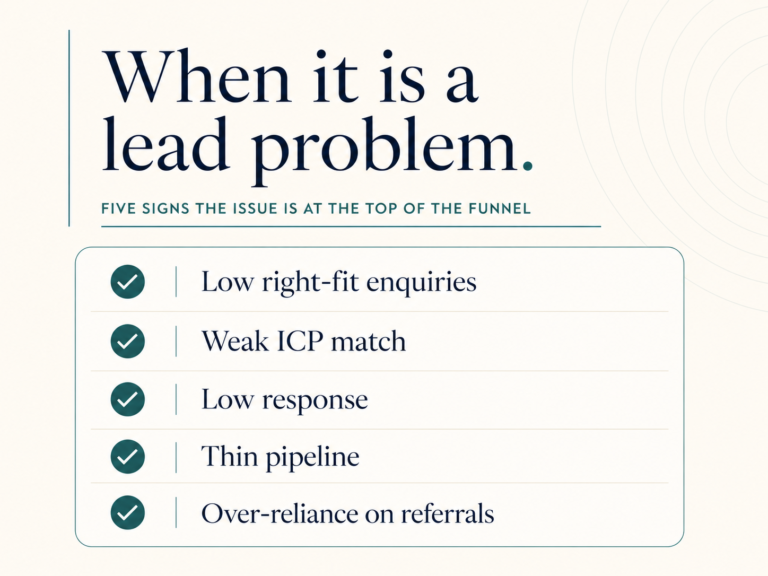
You may have a sales leads problem if there are not enough right-fit opportunities entering the pipeline.
The signs usually look like this:
- website traffic is low or poor quality
- few people enquire without referral
- outbound gets very little response
- leads do not match your ideal customer profile
- sales has too few conversations with real decision-makers
- marketing activity creates attention but not commercial interest
- pipeline coverage is consistently thin
- revenue depends too heavily on existing relationships or referrals
A true lead problem is usually about the top of the funnel.
The right buyers are not seeing you, understanding you or taking the next step.
This is where marketing, visibility, SEO, content, referrals, partnerships and outbound all matter. But more activity only helps if it is pointed at the right market with the right message.
If you attract the wrong leads faster, you have not solved the problem.
You have scaled the admin.What to fix if leads are the problem
Start with the basics.
Ask:
- Are we clear on the ideal customer profile?
- Do we know what triggers the buyer to look for help?
- Are we visible in the places buyers are searching?
- Are our website and service pages clear enough?
- Does our content answer the questions buyers are already asking?
- Is outbound targeted around a real commercial problem?
- Are sales and marketing aligned on what a good lead looks like?
For B2B companies, lead quality is often more important than lead volume.
Ten well-fit opportunities with a real problem are worth more than 100 vague contacts who downloaded something because the button was there and they were having a quiet afternoon.
Signs you have a conversion problem
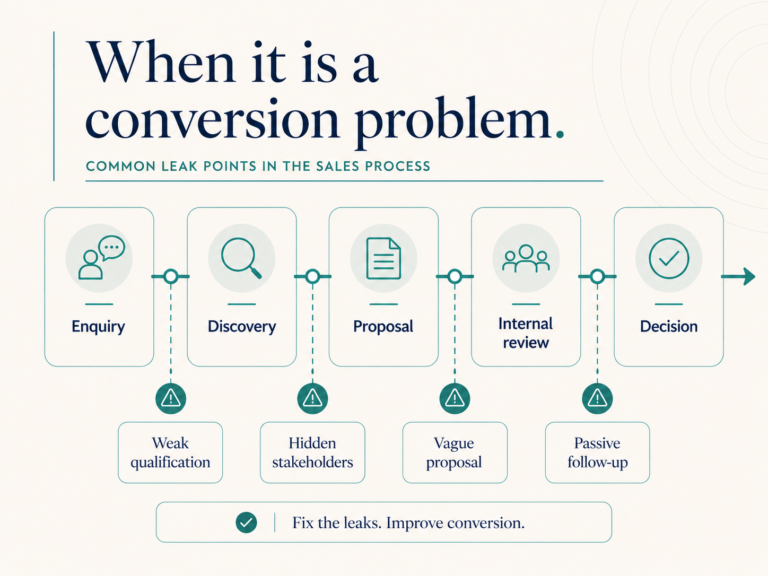
You may have a sales conversion problem if enough leads are entering the pipeline, but they are not turning into closed revenue.
The signs usually look like this:
- plenty of calls, but weak progression
- proposals are sent but deals go quiet
- buyers seem interested but do not commit
- opportunities sit too long in the same CRM stage
- the team keeps blaming timing, price or “no decision”
- follow-up becomes passive
- decision-makers appear late in the process
- the forecast does not match reality
- strong sellers close deals that others lose
This is where many businesses waste money on more leads. They try to pour more into the top of the funnel when the middle of the sales process is leaking.
6sense’s 2025 Buyer Experience Report found that buyers often have a preferred vendor before they speak to sales, and that the preferred vendor goes on to win around 80% of deals.
That means conversion is not only about what happens after a proposal. It is shaped by what the buyer already believes, who they trust and whether the sales process helps them move the decision internally.
What to fix if conversion is the problem
Review the sales process from first conversation to closed outcome.
Ask:
- Are we qualifying against real buying intent?
- Does discovery uncover commercial impact?
- Do we understand who influences the decision?
- Are we clear on the buyer’s decision criteria?
- Does the proposal reflect what the buyer actually cares about?
- Does follow-up help the buyer progress internally?
- Are CRM stages based on buyer progress or seller activity?
- Are we losing to competitors, no decision or delay?
Discovery is usually the first place to look.
A useful question is:
“Once you’ve reviewed the options, what will you need to show internally for this to feel like the right decision?”
That question helps uncover the buying group, proof needed, internal risks, decision criteria and possible blockers.
Good discovery should make the buyer clearer, not just give the seller notes for the CRM.
Signs you have a positioning problem
You may have a sales positioning problem if buyers do not quickly understand why your business is relevant, different or worth choosing.
The signs usually look like this:
- buyers ask basic questions late in the process
- prospects compare you mainly on price
- your offer sounds similar to competitors
- your website explains what you do but not why it matters
- sales has to over-explain the value
- outbound messages feel too broad
- case studies do not clearly prove the outcome
- buyers like the idea but do not feel urgency
- different people in the business describe the offer differently
Positioning is not just a marketing problem.
It affects sales calls, outbound, proposals, pricing, website conversion, buyer trust and deal quality.
If positioning is weak, sales has to work too hard.
They spend too much time explaining, persuading and justifying. Buyers may still like the business, but they do not have a clear enough reason to act.
That is where deals stall.
Not because the buyer hates the offer.
Because they cannot confidently explain why this, why you and why now.
What to fix if positioning is the problem
Start by tightening the commercial message.
Ask:
- Who is this specifically for?
- What problem are we best placed to solve?
- What pain does the buyer already recognise?
- What happens if the issue is ignored?
- What makes our approach credible?
- What proof supports our claim?
- What should buyers remember after reading the page or leaving the call?
Strong sales positioning should make the buyer feel recognised.
It should help them think:
“That is exactly the problem we are dealing with.”
If your message could apply to almost any business, it is probably too broad.
If your service page could sit on a competitor’s website without anyone noticing, it needs work.
Quick diagnostic: leads, conversion or positioning?
Use this as a simple starting point.
| Symptom | Likely issue |
|---|---|
| Not enough right-fit enquiries | Lead problem |
| Lots of enquiries, few serious opportunities | Positioning or qualification problem |
| Good calls, weak progression | Conversion problem |
| Proposals go quiet | Conversion or stakeholder problem |
| Buyers compare mainly on price | Positioning problem |
| Sales says leads are poor, marketing disagrees | Lead definition or positioning problem |
| Founder still needed to close key deals | Process or positioning problem |
| Forecast is unreliable | Conversion process or CRM stage problem |
| Buyers ask basic questions late | Positioning or content problem |
| Deals lost to no decision | Positioning, urgency or buyer enablement problem |
How to decide what to fix first
Do not try to fix everything at once.
Start with the point closest to revenue leakage.
If you have low traffic, few referrals and almost no right-fit conversations, start with visibility and lead generation.
If you have enough conversations but deals do not move, start with qualification, discovery, follow-up and proposal quality.
If buyers do not understand why your offer matters, start with positioning before adding more outreach.
If sales and marketing disagree, start by defining what a good opportunity actually looks like.
That definition should include:
- company fit
- problem fit
- urgency
- decision process
- stakeholder access
- commercial impact
- next step
Without that, both teams will keep arguing from different scorecards.
Useful, if your goal is to turn a revenue meeting into theatre.
What this means for your sales strategy
A stronger B2B sales process starts with diagnosis.
You need to know whether the issue is:
- not enough of the right people entering the pipeline
- enough interest, but weak conversion
- unclear positioning that makes the buyer hesitate
Once you know that, the next step becomes clearer.
Lead problem? Improve visibility, targeting, channel quality and buyer research.
Conversion problem? Improve discovery, qualification, stakeholder mapping, proposals and follow-up.
Positioning problem? Improve message clarity, proof, service pages, outbound relevance and buyer language.
The best sales teams do not just ask, “How do we sell more?”
They ask, “Where are buyers losing confidence?”
That is the question that gets you closer to the real issue.
Common mistakes when diagnosing a sales problem
Mistake 1: Blaming lead volume too quickly
More leads can hide a broken conversion process for a while.
Then it makes the reporting look busier and the revenue problem more expensive.
Mistake 2: Assuming marketing and sales are looking at the same data
Marketing may be measuring enquiry volume.
Sales may be judging commercial fit.
Both can be right and still be misaligned.
Mistake 3: Treating positioning as a website problem
Positioning affects every buyer touchpoint, including outbound, discovery, proposals, follow-up and referrals.
Mistake 4: Ignoring no decision losses
No decision often means the buyer did not feel enough urgency, confidence or internal support to move.
That is worth diagnosing properly.
Mistake 5: Fixing the loudest problem first
The loudest problem is not always the most commercially important one.
Look for the break point closest to revenue.
Sales problem FAQs
How do I know if I have a lead problem?
You probably have a lead problem if there are not enough right-fit prospects entering the pipeline, outbound response is low, website enquiries are weak, and revenue depends too heavily on referrals or existing relationships.
How do I know if I have a conversion problem?
You may have a conversion problem if you have enough leads or sales conversations, but opportunities stall, proposals go quiet, stakeholders appear late, or deals are lost to no decision.
How do I know if I have a positioning problem?
You may have a positioning problem if buyers compare mainly on price, your offer sounds similar to competitors, sales has to over-explain the value, or prospects do not quickly understand why your solution matters.
Should I focus on leads or conversion first?
If your pipeline is too thin, start with lead quality and visibility. If you have enough opportunities but few close, start with conversion. If the wrong people are responding or buyers do not understand the value, fix positioning first.
What is the fastest way to diagnose a sales problem?
Review the pipeline by stage and ask where the buyer loses confidence. Look at lead quality, qualification, discovery, stakeholder involvement, proposal quality, follow-up and reasons for no decision.
Final thought
A sales problem needs diagnosis before action.
More leads will not fix unclear positioning.
Better messaging will not fix a weak conversion process.
More follow-up will not fix poor qualification.
The right fix depends on where the buyer is losing confidence.
Want some help?
If you want to understand whether your sales problem sits in leads, conversion, positioning or the sales process behind them, take the Sales Diagnostic.
For a deeper review across positioning, pipeline, discovery, proposals, CRM rhythm and conversion, book a Strategic Sales Audit.