

Sales activity is easy to measure.
Calls made. Emails sent. LinkedIn messages. Meetings booked. Proposals issued. CRM notes added at 4:58pm because someone suddenly remembered the pipeline review was tomorrow.
The problem is that sales activity doesn’t always create sales revenue.
A team can look busy, sound busy and report busy, while revenue stays flat. That usually means one thing: the business is measuring movement, but not enough of the activity is moving buyers closer to a decision.
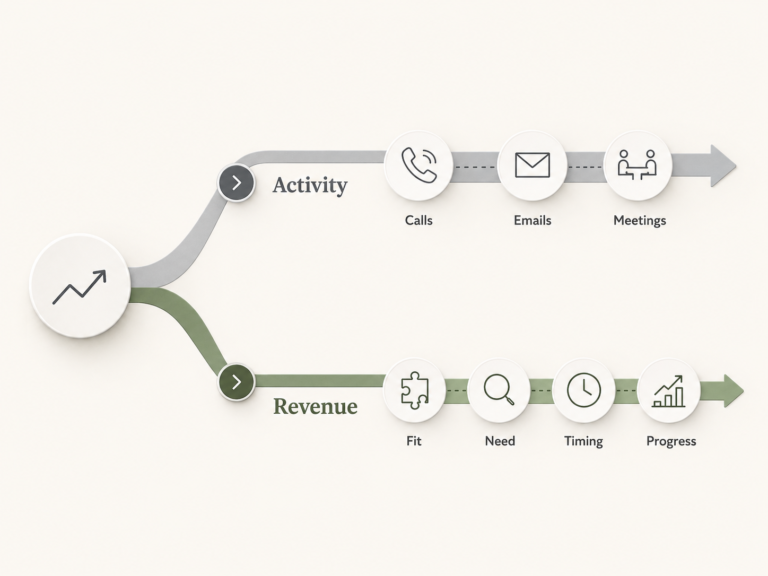
What sales activity actually means
Sales activity is the work your team does to create, progress and close opportunities.
That can include:
- outbound calls
- emails and follow-ups
- LinkedIn outreach
- discovery calls
- demos
- proposals
- pipeline updates
- deal reviews
- negotiation calls
- referral requests
None of these activities are bad. Most are necessary.
But they only matter commercially when they help the right buyer take the next useful step.
That distinction matters because modern B2B buyers are doing more research before they speak to sales.
HubSpot’s 2025 State of Sales Report found that 74% of sales professionals believe AI is making it easier for buyers to research products, and sales teams are increasingly being used to build confidence, support internal buy-in and help buyers make sense of options.
So, the question isn’t, “Is the team active?”
The better question is, “Is this activity helping the buyer decide?”
Why sales activity doesn’t always turn into revenue
There are usually six reasons.
1. The activity is aimed at the wrong buyers
High sales activity can hide weak targeting.
If the team is chasing companies that look vaguely relevant but don’t have the right problem, budget, timing or internal pressure, the numbers will look healthy at the top of the funnel and weak everywhere else.
This is where sales teams get trapped.
More calls create more conversations. More conversations create more “opportunities”. More opportunities create a bigger pipeline. Then the pipeline quietly bloats with deals that were never likely to close.
Clari’s 2025 enterprise revenue benchmark, based on 10 million opportunities, found that only 25% of sellers complete assigned sales tasks and 98% of companies fail to track closed-lost reasons consistently. That makes it harder to understand which activity is creating revenue and which activity is just adding noise.
A pipeline full of poor-fit opportunities isn’t a sales asset. It’s admin wearing a blazer.
2. The team is measuring effort instead of progress
Activity metrics are useful, but they’re incomplete.
A rep might send 200 emails in a week. That sounds productive until you ask:
- How many reached the right person?
- How many created a meaningful reply?
- How many moved into a qualified conversation?
- How many progressed beyond curiosity?
- How many had a clear commercial reason to act now?
This is where many sales dashboards become misleading. They show effort, but not intent.
Salesforce’s 2026 sales statistics highlight the same problem from another angle: sellers use an average of eight tools to close deals, and 42% feel overwhelmed by too many tools. Overwhelmed sellers are also 45% less likely to attain quota.
So when sales activity is high but revenue is low, the issue might not be laziness. It might be friction, poor focus or a system that rewards visible work over valuable work.
3. Buyers are not ready enough to move
A buyer can attend a meeting and still be nowhere near a decision.
That’s annoying, but fairly human. We all browse things we’re not ready to buy. Some people have entire Pinterest boards for kitchens they’ll never renovate. B2B buyers are not immune.
Gartner’s 2026 research found that buyers now use an average of seven information sources during a purchase. It also found that 67% prefer a sales rep-free experience, while 70% prefer a completely digital, self-service buying experience.
This changes the role of sales activity.
The best activity does not simply “check in” or push for the next call. It helps the buyer clarify the problem, compare options, build internal confidence and understand the cost of doing nothing.
Weak activity asks, “Any update?”
Strong activity gives the buyer a reason to keep moving.
4. Sales conversations are happening, but qualification is too loose
A meeting is not automatically an opportunity.
This sounds obvious. Apparently, it still needs saying.
Qualification should confirm whether there is a real business problem, a reason to act, a decision process, commercial fit and enough access to the people involved.
When qualification is weak, sales teams confuse interest with intent.
That usually leads to:
- too many proposals being sent too early
- deals sitting in the CRM with no next step
- low-quality opportunities reaching forecast
- salespeople spending time with buyers who are curious but not committed
- leaders finding out too late that the pipeline was never real
Sales activity turns into revenue when qualification protects the team’s time.
It fails when every conversation is treated like a deal.
5. Follow-up is happening, but it isn’t useful
Follow-up is one of the most abused words in sales.
A useful follow-up helps the buyer progress. A weak follow-up reminds them you still exist. There’s a difference.
Good follow-up might include:
- a sharp summary of what was discussed
- the commercial problem in the buyer’s language
- agreed next steps
- proof relevant to their situation
- a clear decision point
- a useful question that moves the deal forward
Weak follow-up usually sounds polite, vague and slightly desperate.
HubSpot’s 2025 sales research found that sales professionals increasingly see their role as helping buyers feel confident in decisions and navigate internal buy-in. That means follow-up needs to support decision-making, not simply chase a reply.
If the follow-up doesn’t help the buyer think, prioritise or act, it’s probably just inbox decoration.
6. Sales and marketing are creating activity in different directions
Revenue suffers when marketing creates attention, sales creates conversations, and nobody checks whether those conversations are with the right people about the right problem.
This is common in B2B companies where marketing is measured on leads and sales is measured on conversion, but the two teams don’t share a clear definition of quality.
The result is predictable:
Marketing says sales doesn’t follow up properly.
Sales says the leads are weak.
Leadership asks why revenue is still inconsistent.
Everyone opens another dashboard. Spirits decline.
The fix is to measure the full journey from source to revenue. Which channels create qualified opportunities? Which messages attract the wrong buyers? Which lead sources create long sales cycles? Which deals close, retain and expand?
Sales activity improves when the whole commercial system learns from revenue, not just lead volume.
The sales activity metrics worth looking at
You don’t need to stop measuring activity. You need to connect it to outcomes.
Start with these:
- activity to meaningful conversation rate
- meaningful conversation to qualified opportunity rate
- qualified opportunity to proposal rate
- proposal to close rate
- average sales cycle length
- no-decision rate
- closed-lost reason accuracy
- stalled deal percentage
- follow-up completion after key meetings
- number of stakeholders engaged per active deal
Salesforce reported that 57% of sales professionals say the sales cycle is getting longer. That makes these progression metrics more important, because longer sales cycles can make weak activity look productive for longer than it deserves.
How to fix sales activity that isn’t converting
Start by auditing the activity that already exists.
Look at the last 20 to 30 opportunities and ask:
- Where did the opportunity come from?
- Was it a strong-fit buyer?
- What problem did they need to solve?
- Was there a clear reason to act?
- Who was involved in the decision?
- Where did the deal slow down?
- What activity helped the deal progress?
- What activity made no difference?
- Why did the deal close, stall or get lost?
Then look for patterns.
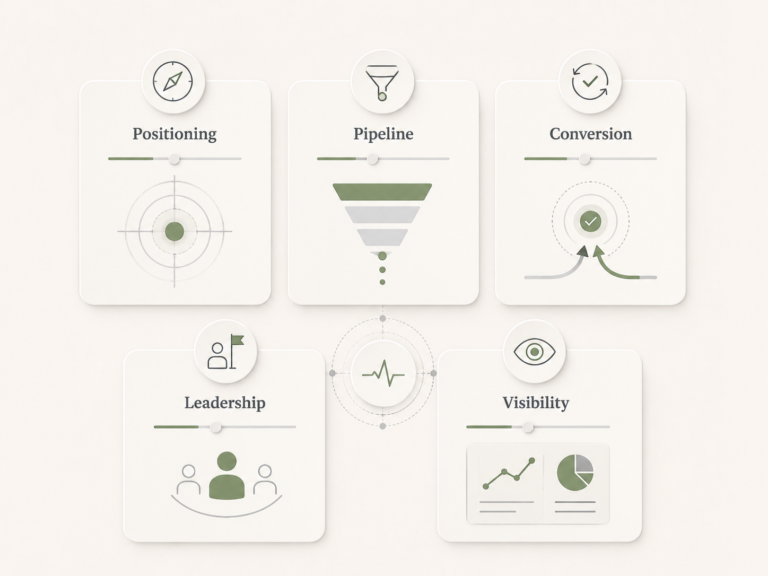
If poor-fit buyers keep entering the pipeline, the problem may be positioning or targeting.
If good-fit buyers engage but don’t progress, the issue may be conversion, follow-up or deal control.
If nobody trusts the CRM, the problem may be visibility.
If the team is busy but nobody owns the rhythm, the issue may be leadership.
This is why sales activity needs diagnosis before more effort gets added. More activity can help, but only when the commercial system underneath it is clear enough to convert.
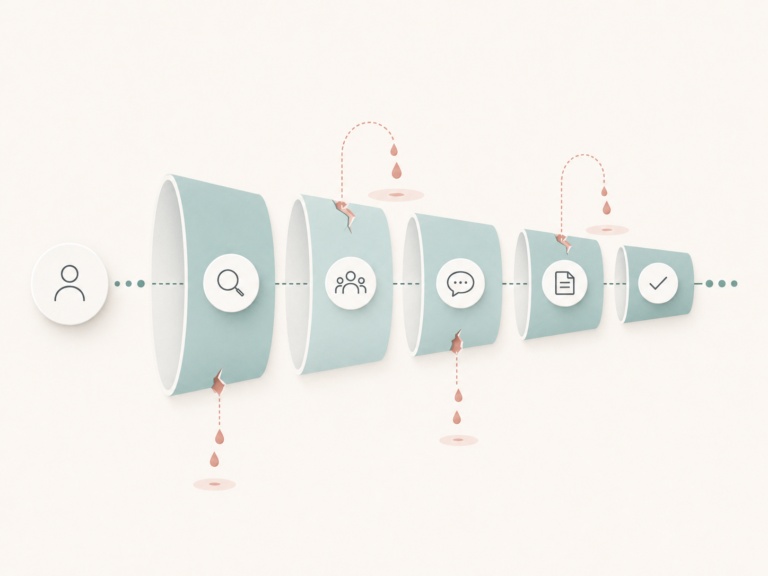
Find out where your sales is actually breaking down with our accurate Sales Diagnostic Tool
If your team is busy but revenue still feels inconsistent, the answer is rarely “just do more”.
You need to know which part of the sales system is weakening: positioning, pipeline, conversion, leadership or visibility. You could learn more about our Strategic Sales Audit or…
Take the sales diagnosis to see where sales activity is being lost and what to fix first.