

Why small business marketing fails when sales isn’t ready
Small business marketing can generate attention, enquiries and sales conversations, yet still appear to have failed. The problem often sits after the lead arrives.
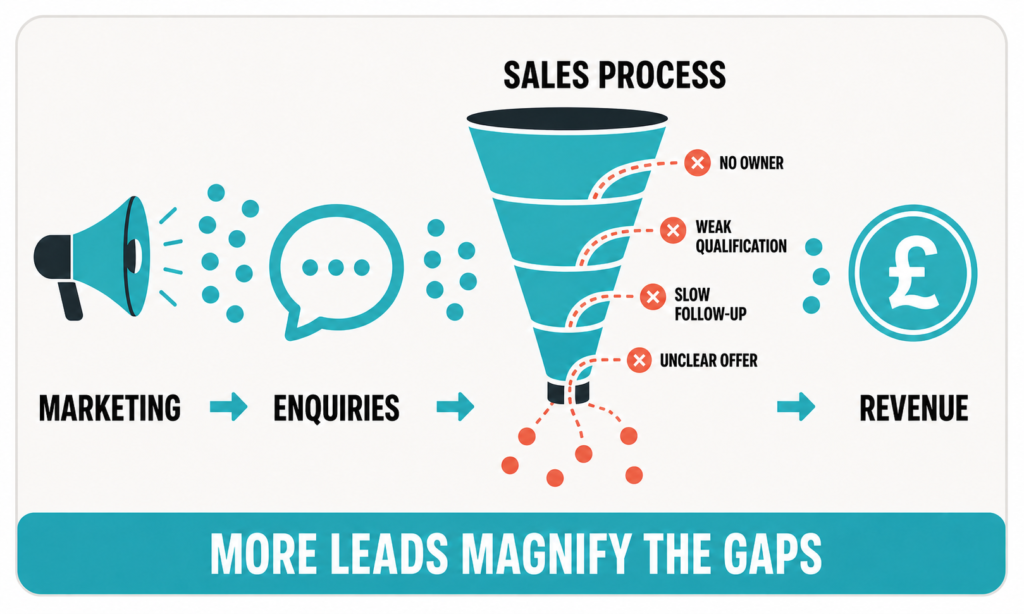
If nobody owns the follow-up, qualification is weak, the offer is hard to explain or the sales process relies on the founder remembering what to do next, more marketing creates more leakage. You pay to bring people in, then make it unnecessarily difficult for them to buy.
Before you increase the budget, add another channel or commission more content, check whether sales is ready to convert the interest you already create.
What does it mean for sales to be ready for marketing?
Sales readiness means your business can respond to, qualify and progress a suitable enquiry in a consistent way.
At a minimum, you know:
- who you want to attract
- which problem you solve for them
- why they should choose you
- who owns each new enquiry
- how quickly you will respond
- which questions help you qualify fit
- what happens after each sales conversation
- where opportunities are recorded
- which proof helps buyers make a decision
- which numbers tell you whether the process is working
This does not require a vast sales department, a CRM that needs its own project manager or a 74-page playbook.
A small business needs a process that is clear enough to use every time.
Marketing and sales have different jobs
Marketing helps the right people find you, understand the problem, recognise your relevance and build trust in your business.
Sales helps a potential buyer decide whether there is a good fit, understand the value, involve the right people and move towards a sensible decision.
| Marketing creates | What sales needs to do next |
|---|---|
| Website visits | Make the offer and next step easy to understand |
| Content engagement | Recognise intent and respond appropriately |
| Enquiries | Qualify fit, need, timing and the decision process |
| Event or webinar leads | Follow up with context, rather than a generic chase |
| Demo or consultation requests | Run a useful conversation and agree a next step |
| Buyer confidence | Reinforce that confidence with proof and a consistent experience |
When the handover is vague, marketing activity and revenue drift apart. The dashboard may show clicks, downloads and leads while the bank account remains unimpressed.
Why small business marketing needs sales readiness in 2026 & beyond
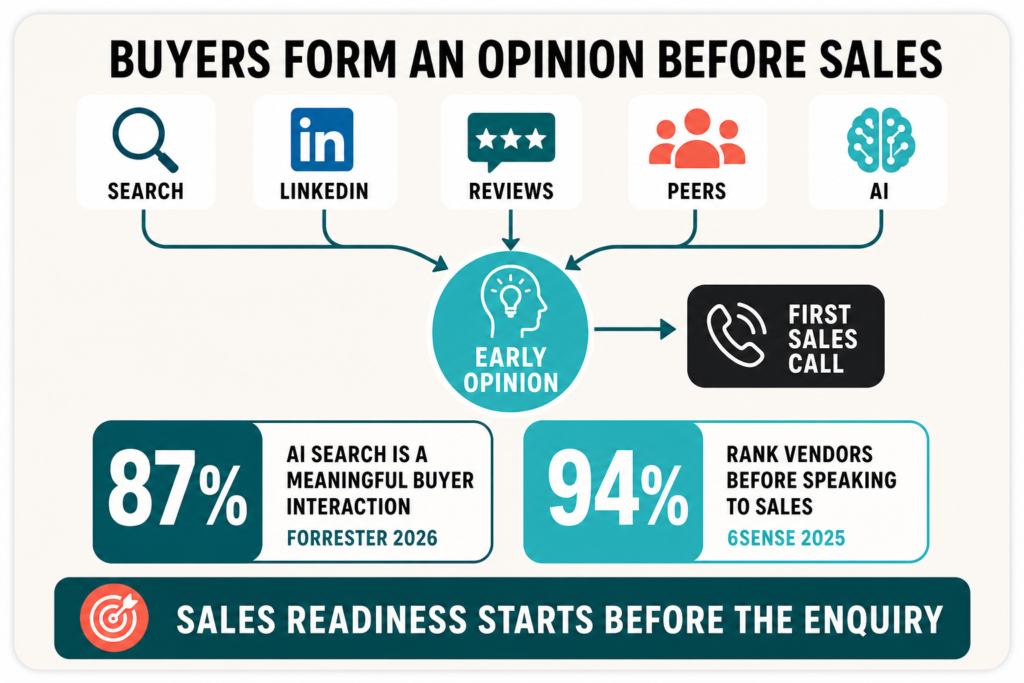
Buyers can now research a problem, compare approaches and investigate suppliers before speaking to anyone. Search engines, LinkedIn, review sites, peer recommendations and AI tools all shape that early opinion.
Forrester reported in 2026 that 87% of B2B buyers regarded generative AI conversational search as a meaningful interaction.
The 6sense 2025 Buyer Experience Report found that 94% of surveyed B2B buyers used large language models during the buying process. It also found that buyers ranked their preferred vendors before speaking to sellers in 94% of buying journeys.
That changes the point at which sales readiness begins. It starts before the enquiry.
Your articles, service pages, case studies, LinkedIn activity, emails and sales conversations need to tell a consistent story. The buyer should not meet a sharp, commercially useful article and then receive a generic “just checking in” email from 2012.
Marketing builds the expectation. Sales has to meet it.
For a practical look at the wider shift, read what 2026 B2B buying behaviour means for sales.
Seven signs marketing is exposing a sales problem
1. “We need more leads” is the answer before anyone checks the data
More leads can be useful, but first find out what happens to the leads you already have.
Look at the last 20 suitable enquiries or opportunities:- How many received a prompt response?
- How many were qualified?
- How many reached a genuine sales conversation?
- How many received a proposal?
- How many bought?
- Where did the others stop?
If you cannot answer those questions, lead volume is only one possible issue. A full bucket is not much help when the bottom has several holes in it.
2. Nobody clearly owns a new enquiry
Shared responsibility often turns into delayed responsibility.
Every enquiry needs a named owner, a response expectation and a defined next action. This matters whether leads arrive through a contact form, referral, event, email, LinkedIn or an AI-assisted search.
The first response should show the buyer that someone has noticed, understood why they got in touch and knows what should happen next. A prompt, relevant acknowledgement is enough to begin.
3. Qualification depends on instinct
Many founders know a good opportunity when they see one. That works until other people join the process, volume increases or the founder becomes the bottleneck.
Agree a small set of qualification criteria. For example:- Is this the type of business we help?
- Is the problem one we solve well?
- Is the problem important enough to act on?
- Who is affected by it?
- Who will be involved in the decision?
- Is there a realistic reason to change now?
Qualification protects your time and the buyer’s time. It also helps marketing learn which sources produce useful opportunities, rather than simply the most form submissions.
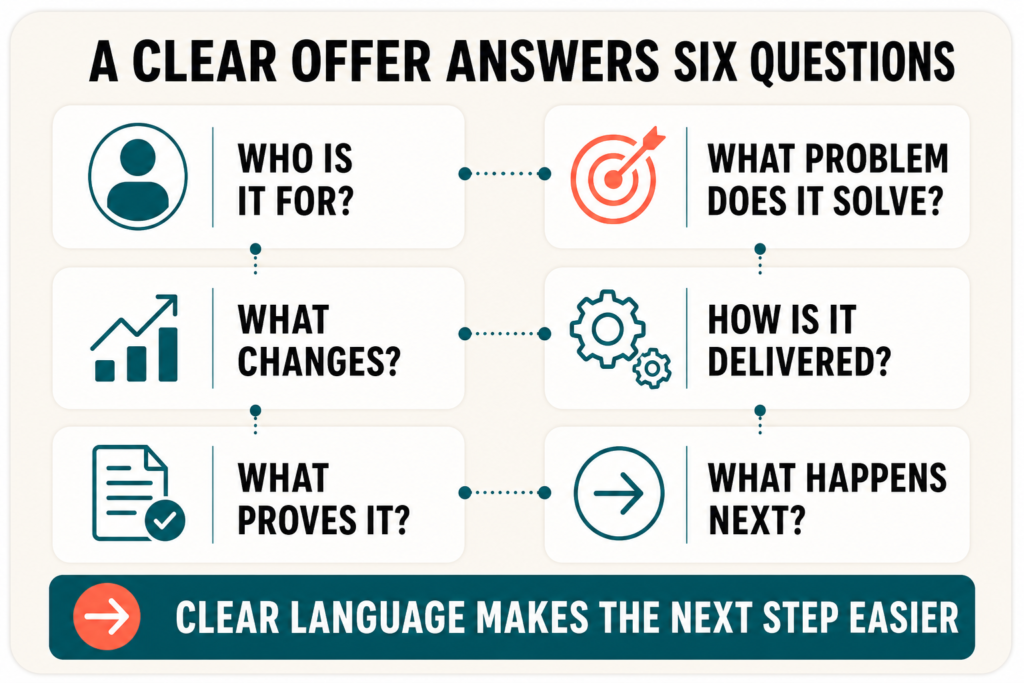
4. The offer takes too long to explain
- who the offer is for
- which problem it addresses
- what changes as a result
- how the work is delivered
- what evidence supports the claim
- what to do next
Clear language matters because people tend to respond more positively to information that is easier to process. Research into processing fluency supports a fairly sensible conclusion: making people work harder to understand you rarely improves the buying experience.
If the offer has not been properly tested yet, speak to real potential buyers before adding more reach. Their questions, hesitation and buying language will tell you far more than another afternoon adjusting the strapline.
Work on your sales and marketing alignment so the same buyer language, proof and priorities carry through to every sales conversation.
5. Follow-up relies on memory
One email followed by hope is not a follow-up process.
Buyers get distracted. Priorities change. Other people enter the decision. A useful follow-up adds context or helps the decision move. That could include:- a short summary of the problem discussed
- an answer to a question raised on the call
- a relevant case study
- a comparison or decision guide
- an agreed action with a date
- a direct question about whether the priority has changed
Keep it human. Automation can support the process, but a sequence of increasingly cheerful reminders is unlikely to rescue a weak proposition.
6. The CRM records history instead of guiding action
A CRM should show what is happening, what needs attention and what comes next.
For a small business, the basics are enough:- agreed sales stages
- a named owner
- the source of the opportunity
- the buyer’s problem and priority
- the last meaningful contact
- the next action and date
- the likely value
- the reason an opportunity was won or lost
When every open opportunity is sitting in “proposal sent”, that stage has become a waiting room.
7. Marketing and sales measure different versions of success
Marketing may celebrate traffic and leads. Sales may complain that lead quality is poor. Leadership may look only at revenue at the end of the month.
All three need a shared view of the journey.
Track a small number of connected measures:- Suitable enquiries by source
- Response rate and response time
- Enquiry-to-conversation conversion
- Conversation-to-qualified-opportunity conversion
- Opportunity-to-sale conversion
- Average sales cycle
- Common reasons for loss or delay
This gives marketing useful feedback. It also stops sales from blaming lead quality without evidence, which is a popular hobby in some businesses. Sales and marketing alignment starts with a shared definition of a suitable lead and a shared view of lead conversion.
A ten-question sales readiness check
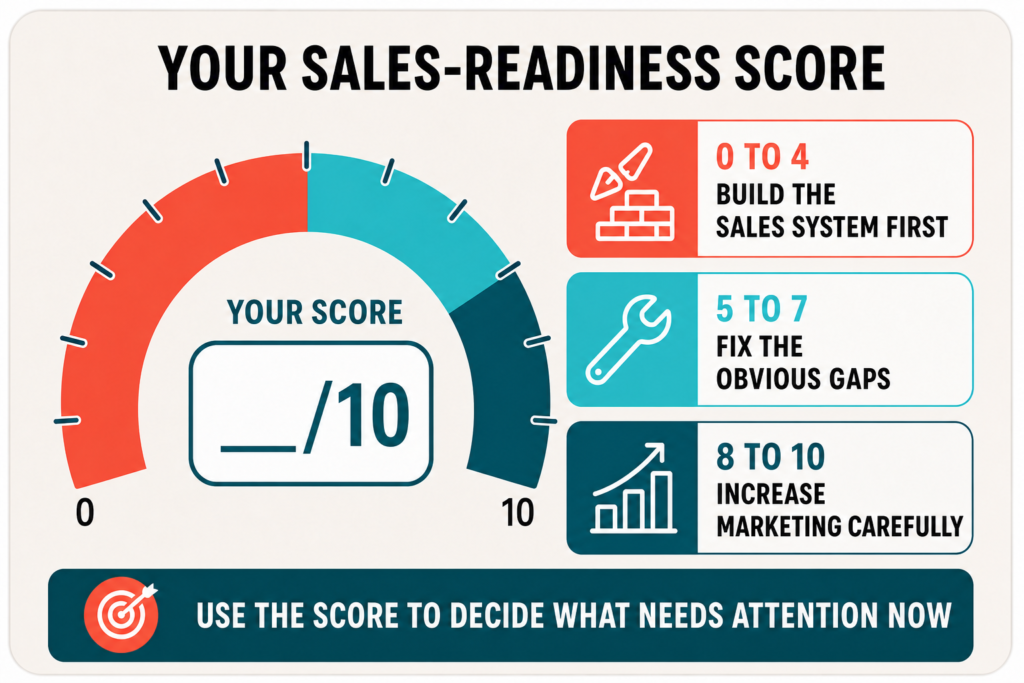
Give your business one point for every question you can answer with a clear yes.
- Can we describe our ideal buyer without saying “any business that needs us”?
- Can we explain the buyer problem and commercial impact in plain English?
- Has the offer been tested with real potential buyers or customers?
- Does every new enquiry have a named owner?
- Do we have an agreed response time?
- Do we use consistent qualification questions?
- Are our sales stages based on buyer progress?
- Does every live opportunity have a next action and date?
- Do we have relevant proof for the objections buyers raise?
- Can we see conversion by stage and lead source?
8 to 10: You have a useful foundation. Increase marketing carefully and monitor where conversion changes.
5 to 7: Marketing can continue, but fix the obvious gaps before adding significant spend.
0 to 4: Scaling lead generation will probably scale confusion and wasted effort too. Build the minimum sales system first.
The score is a starting point. Use it to decide what needs attention now.
How to get sales ready before spending more on marketing
Start with the revenue outcome and work backwards
Define the commercial result you want. Then work backwards through:
- sales needed
- qualified opportunities needed
- useful sales conversations needed
- suitable enquiries needed
- marketing activity needed
Use your own conversion data wherever possible. Generic benchmarks can help you ask questions, but they cannot tell you how your buyers behave.
Build a minimum viable sales process
For most small businesses, the first version can fit on one page. That is enough to turn a small business sales strategy into something people can follow:
- An enquiry arrives and is recorded.
- A named person responds within the agreed time.
- Fit and urgency are checked.
- A useful discovery conversation takes place.
- Both sides agree the next step.
- Proof or a proposal is matched to the buyer’s priorities.
- Follow-up is scheduled.
- The outcome and reason are recorded.
Use the process, review it and improve it. Waiting for perfection is an excellent way to avoid learning anything.
Make content useful inside the sales process
Strong content does more than attract traffic. It helps buyers diagnose a problem, compare choices, answer internal questions and feel more confident about a decision.
Map each useful piece of content to a sales question:
- What problem does this help the buyer recognise?
- Which objection does it address?
- Who in the buying decision would find it useful?
- At which sales stage should the team share it?
For more on that, read how B2B content builds buyer confidence before sales speaks.
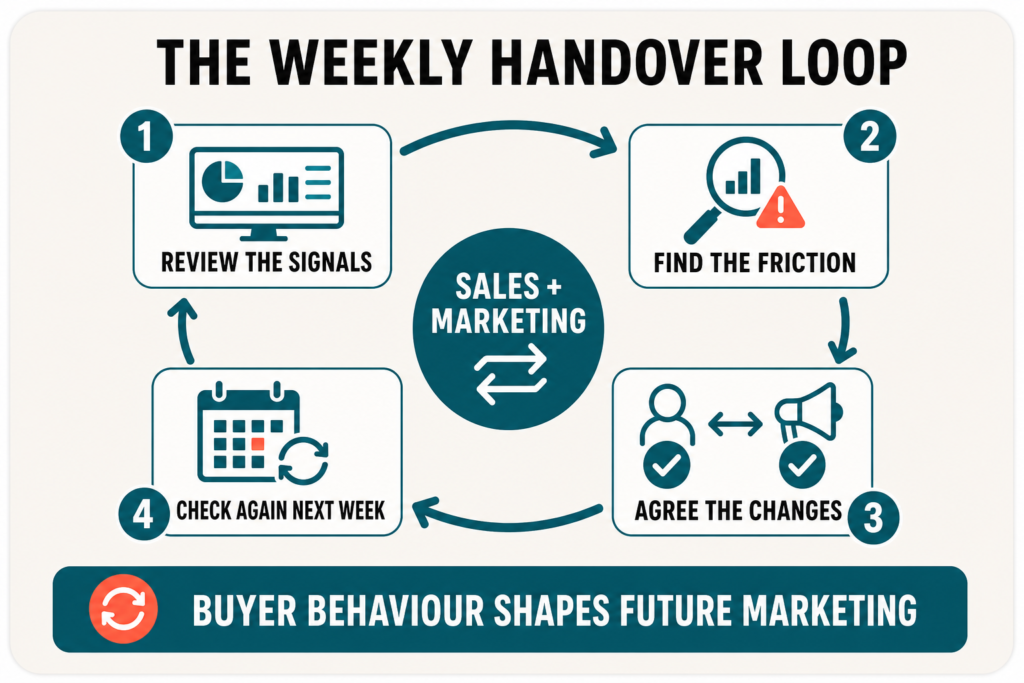
Review the handover every week
- Which sources produced suitable opportunities?
- Which enquiries received no response or a slow response?
- Where are opportunities stuck?
- Which buyer questions keep coming up?
- Which claims need better proof?
- What should marketing change?
- What should sales change?
This creates a feedback loop between real buyer behaviour and future marketing.
Test one important change at a time
Change the response process, qualification questions, discovery structure or proposal format, then watch what happens.
Running six experiments at once may feel productive, but it makes the result hard to interpret. Small businesses rarely lack ideas. They usually lack a clean test and the patience to learn from it.What I have learned from building sales and marketing together
I have built sales, marketing and operational functions from scratch in founder-led businesses, supported growing SMEs and worked inside a larger multi-brand organisation to connect marketing activity with commercial priorities.
The same pattern appears in different-sized businesses: extra marketing magnifies whatever happens next.
When the offer is clear and the sales process works, marketing gives it more opportunities to perform. When follow-up is inconsistent, the CRM is unreliable or the founder has to rescue every deal, marketing sends more people towards the same weak points.
I have also seen the other side. One client reported a 17% increase in revenue within a quarter after changes to the sales system, pipeline and execution. Improving how the business handled existing opportunities produced the useful commercial change.
That is why I would diagnose positioning, pipeline and conversion before recommending more activity.
The answer may still be more marketing. You will have a much better idea of what that marketing needs to achieve and what the business must do when it works.
Before you add another marketing channel
Ask one question:
If the right buyer contacted us tomorrow, could we give them a clear, consistent and confident route to a decision?
If the answer is yes, marketing has something solid to amplify.
If the answer is uncertain, find the gap. Fix the ownership, offer, qualification, follow-up, proof or pipeline stage that is getting in the way.
Then spend.
If you want an experienced view of where sales performance is being lost, explore sales consultancy for growing B2B businesses.
Where is your sales process losing revenue?
Take the Sales Diagnosis to score your positioning, pipeline and conversion. See what is working, where opportunities are getting stuck and what to fix first.

Frequently asked questions
Can marketing work without a formal sales process?
Marketing can create awareness and enquiries without a formal sales process. Conversion will usually become inconsistent when follow-up, qualification and next steps depend on individual memory.
A simple documented process gives a small business enough structure to learn and improve.
Should a small business pause marketing until sales is ready?
Usually, no. Keep useful brand, content and customer communication active while you repair the sales gaps.
Delay large increases in advertising or lead generation until the business can handle and measure the extra demand.
What is the first sign of poor sales and marketing alignment?
The first sign is often disagreement about lead quality.
Marketing points to volume, sales says the leads are poor and nobody can show conversion by source or explain where suitable enquiries stopped progressing.
What should a small business fix first?
Start with ownership and visibility.
Give every enquiry an owner, record it in one place and require a clear next action. Then review qualification, messaging and the sales stages using evidence from real opportunities.
How do you measure whether marketing is helping sales?
Track suitable enquiries, sales conversations, qualified opportunities and revenue by source.
Add response time, stage conversion and reasons for loss. This shows whether marketing is attracting the right people and whether sales is helping them progress.