

B2B buyer research is no longer happening in one place, and where your buyers search changes what they believe, what they trust and what they expect from your sales process.
That matters more than most businesses think.
A buyer who finds you through Google is usually in a different headspace from someone who discovers you on LinkedIn.
A buyer asking ChatGPT for “best sales consultancy for B2B companies” is not seeing the same world as someone comparing websites, reading reviews, watching YouTube explainers or asking peers in a private community.
Same problem.
Different search route.
Different version of the market.
Probably they have different intentions too!
That is why “just create more content” is weak advice – one is likely more ready to buy, the other, (on Linkedin), not yet! So the buyer journey needs to accommodate that. Content only works when it shows up in the places your buyers are actually using to make sense of the decision, based on the phase of the journey they are at.
Search is no longer one behaviour
For years, search mostly meant Google. Now search happens everywhere.
Google.
LinkedIn.
YouTube.
Reddit.
TikTok.
Instagram.
AI tools.
Review sites.
Private Slack groups.
WhatsApp messages.
Peer communities.
Comment sections full of people who should probably go outside.
Gartner’s recent B2B buyer research found that buyers used an average of seven information sources during a recent purchase, while 45% used GenAI during that purchase.
McKinsey’s B2B research also shows buyers using around ten channels across the purchasing journey.
In other words, B2B buyer research has become fragmented.
Your buyer is not sitting quietly in one funnel, patiently waiting to be nurtured by your three-email sequence.
They are building a view of the problem across multiple places before you know they exist – and so…. B2B buyer behaviour has changed!
Each search platform creates a different version of the problem
This is the part businesses miss.
Different platforms do not just show different content. They create different expectations.
Google shows intent
Google is still strong when someone knows what they are looking for.
They search:
- B2B sales consultant
- how to improve sales conversion
- why is my sales pipeline not converting
- fractional sales leadership
- CRM sales process audit
That kind of search usually has commercial intent behind it.
The buyer may not be ready to book a call yet, but they are actively trying to understand the problem.
This is where your SEO articles, service pages, comparison content and diagnostic guides matter.
If your content is vague here, you lose the buyer before the first conversation.
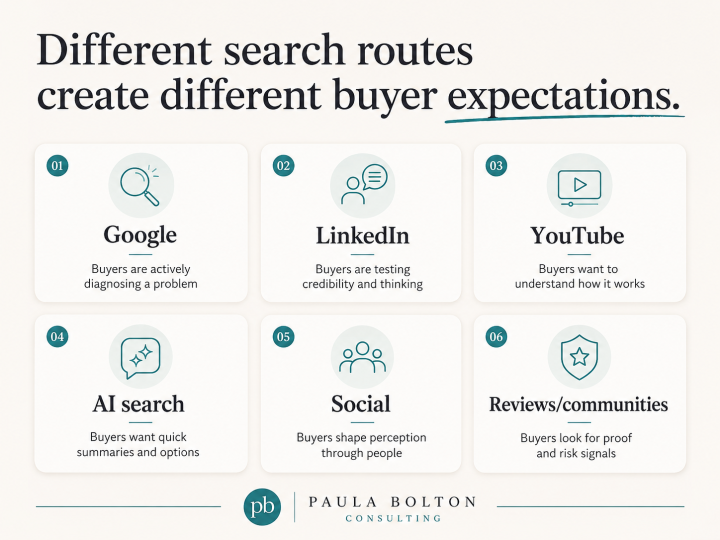
LinkedIn shows authority
LinkedIn is where buyers test your thinking.
They look for:
- what you believe
- how you explain problems
- whether you understand their world
- whether your experience feels credible
- whether other people trust you
This is not always direct search. Often, it is discovery through posts, comments, profiles, shared articles and second-degree trust.
Edelman and LinkedIn’s B2B thought leadership research shows that hidden buyers actively discover, consume and evaluate thought leadership. That matters because the person reading your content may not be the person who books the call.
They may still influence the decision.
This is why thought leadership cannot just be “five tips to improve your sales”. Useful, yes. Memorable, no.
Your point of view needs to make a buyer think:
“They understand the problem behind the problem.”YouTube shows how it works
YouTube is where buyers go when they want explanation, demonstration or depth.
They want to see:
- how something works
- what a process looks like
- how others solved a similar issue
- whether the person explaining it feels credible
For B2B services, YouTube is not only for entertainment. It can support trust before the buyer speaks to you.
A short video explaining why a sales pipeline looks full but still fails to convert can do more than a polished brochure.
Mainly because nobody has willingly enjoyed a polished brochure since about 2007.AI search gives buyers shortcuts
AI tools are changing B2B buyer research.
TrustRadius reported that 72% of B2B technology buyers encountered Google AI Overviews in search, while Gartner found that 45% of B2B buyers used GenAI during a recent purchase.
That means buyers are increasingly getting summarised answers before clicking through to websites.
This changes your content job.
Your articles need to be clear, structured and specific enough to be understood by both humans and AI systems.
That means:
- clear titles
- direct definitions
- useful subheadings
- specific examples
- original insight
- credible sources
- practical frameworks
- FAQs that answer real buyer questions
If your content is thin, generic or full of phrases everyone else is using, it becomes easier to ignore and harder to surface.
AI search rewards clarity.
Annoying, really. Clarity keeps winning.Social search shapes perception
Social media is now a search behaviour, especially for younger buyers and future decision-makers.
Sprout Social’s 2025 research found that 41% of Gen Z turn to social platforms first when looking for information, ahead of traditional search engines.
That is not just relevant for consumer brands.
It changes how people learn to evaluate expertise.
Buyers are increasingly used to finding answers through people, not just companies.
That means the person behind the business matters. Your profile matters. Your posts matter. Your tone matters. Your comments matter. The way you explain something in plain English matters.
Corporate content still has a place, but buyers are more likely to trust a real person explaining a real problem than a brand saying it provides “tailored solutions”.
Lovely phrase. Straight to the bin.
Review sites and communities reduce risk
When buyers are closer to a decision, they start looking for risk signals.
They want to know:
- who else has used this
- what went wrong
- what the vendor is really like
- whether the claims hold up
- whether the product or service creates hidden work
- whether people like them got a good result
That is why case studies, testimonials, reviews and proof matter.
6sense’s research shows that buying groups often rank preferred vendors before speaking to sellers. That means your reputation is being formed quietly, before your sales process starts.
If buyers cannot find credible proof, they will fill the gaps themselves.
Usually not in your favour. Buyers are cheerful like that.The danger is assuming one platform tells the whole truth
Search is useful.
Search is also messy.
A Nature study found that searching online to evaluate false news can sometimes increase belief in it. Another 2025 study on search behaviour found that the way people phrase queries affects the quality of results they see.
That should make businesses pause.
Buyers are not always finding the best answer.
They are finding the answer shaped by:
- the platform they use
- the query they type
- the algorithm deciding what appears
- their previous behaviour
- the content format they prefer
- who they already trust
- what feels emotionally convincing
This is why sales messaging needs to meet the buyer with context, not just claims.
Your job is not only to be visible.
Your job is to help the buyer think better.What this means for your sales messaging
If where buyers search shapes what they sell themselves internally, your messaging needs to do more than describe your offer.
It needs to help buyers diagnose the issue.
That means your content should answer questions like:
- What problem are they really trying to solve?
- What are they likely misunderstanding?
- What would make the issue worse if ignored?
- How do they compare possible solutions?
- What proof do they need to trust the route forward?
- What would a hidden buyer need to see?
- How can they explain the decision internally?
This is where most sales content falls apart.
It is too focused on the seller.
We do this. We believe that. We offer these services. We have this framework. We are passionate about helping businesses grow.
Fine.
But the buyer is asking:
- Is this my problem?
- Do these people understand it?
- Can I trust them?
- Will this help me make a better decision?
- Can I justify this internally?
Better content starts there.
How to use this in your business
Start by mapping your buyer’s search behaviour.
Ask:
- Where do buyers go when they first notice the problem?
- What do they search when they know something is wrong but cannot name it yet?
- What content appears when they search for your category?
- What would they ask ChatGPT or another AI tool?
- What are they likely to check on LinkedIn?
- What proof do they look for before booking a call?
- What would a cautious stakeholder search after receiving your proposal?
Then build content around the journey.
For example:
Early problem stage Create diagnostic articles like “Why your B2B sales process isn’t converting” or “Why your sales pipeline looks full but revenue is inconsistent”.
Comparison stage Create content that explains options, trade-offs and when each route makes sense.
Trust stage Use case studies, proof, testimonials and founder-led insight.
Internal decision stage Create checklists, business case summaries, proposal guides and resources the buyer can share with their team.
This is how content starts supporting sales properly.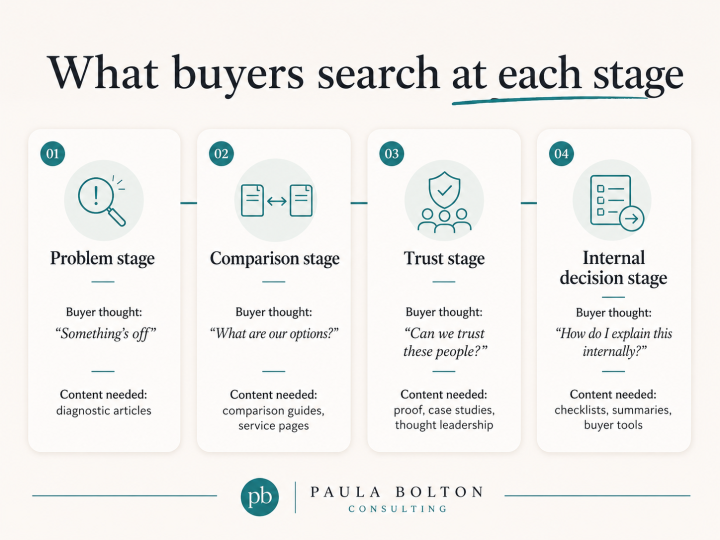
The practical rule
- Do not create content for “the internet”.
- Create content for the specific moment your buyer is in.
- Google content should help them diagnose and compare.
- LinkedIn content should show judgement, experience and point of view.
- YouTube content should explain.
- AI-friendly content should be clear, structured and specific.
- Case studies should reduce risk.
- Resources should help the buyer move the decision internally.
- That is how search starts shaping sales.
Final thought
Where your buyer searches shapes what they believe.
What they believe shapes what they trust.
What they trust shapes what they are willing to buy.
If your content only exists in one format, on one platform, built around your offer rather than the buyer’s decision process, you are probably missing part of the sale before it becomes visible.
The question is not just:
“Are we being found?”
The better question is:
“When buyers find us, does our content help them think, trust and move forward?”
A Strategic Sales Audit will show where your messaging, content and sales process are helping the buyer make progress, and where they are creating friction.