Before I ask a sales manager to do more sales coaching, I want to know what we’re taking off their plate.
Because “coach the team more” sounds reasonable until you look at the job we’ve given them.
Own the forecast. Check the CRM. Recruit. Onboard. Approve discounts. Attend the leadership meeting. Sort out the difficult customer. Help close the deal.
And develop everyone while you’re at it.
Then, when performance disappoints, we ask why the coaching hasn’t happened.
I think we need to look harder at how we’ve designed the role.
The job description and the actual job
Gartner’s Q3 2026 CSO Report says 52% of frontline sales managers report a mismatch between their daily tasks and formal job descriptions.
The same report says managers with role clarity are 3.2 times more likely to achieve strong team performance.
That is an association, not a promise that rewriting a job description will transform your results. But it gives leaders a good reason to examine what their managers actually spend time doing.
My view is – if coaching matters to the business, the manager’s working week needs to reflect it.
A recurring calendar invitation is a start. The harder decision is what stops taking priority over it.

A pipeline review can finish without anyone learning anything
There is a useful distinction here.
A pipeline review asks:“What will close, when will it close, and what could stop it?”A coaching conversation asks:
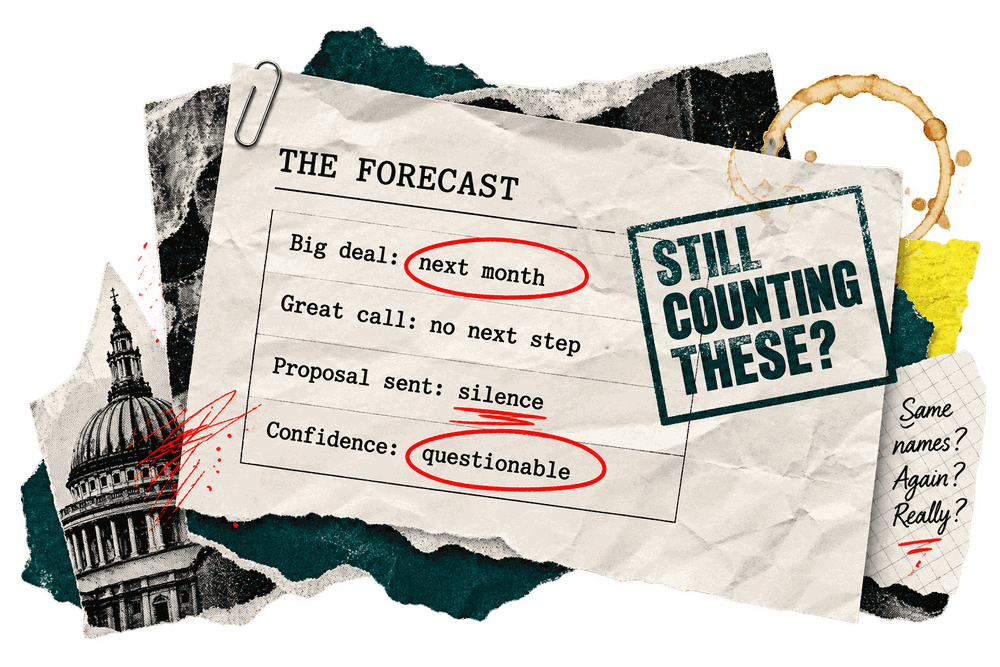
“How did you reach that judgement, and what could you do differently?”Both belong in a sales team. They serve different purposes. Imagine a salesperson says a proposal should close this month because the buyer was positive. The manager could ask them to chase it, update the close date and report back on Friday. Or they could examine the judgement behind the forecast:
- “What did the buyer actually agree to?”
- “What tells you the decision can happen this month?”
- “What would you need to find out before putting this in commit?”
That conversation helps with the live opportunity. It also gives the salesperson a better way to assess the next one.
My test for coaching is whether the person leaves better able to handle a similar situation themselves.
Deal rescue can become an expensive habit
I understand the appeal of stepping in.
There is a target to hit. The deal matters. An experienced manager can often move a conversation forward quickly.
Sometimes that is exactly what the business needs.
But if the manager keeps taking over discovery, rewriting proposals and handling every difficult negotiation, I would question what the team is learning.
After more than 20 years in sales, commercial leadership and business ownership, I care about whether capability stays in the business.
A manager who helps win an important deal creates value.
A manager who helps three people improve how they qualify, negotiate or progress their own deals can create value across many more opportunities.
The problem starts when rescuing today’s revenue repeatedly consumes the time needed to improve tomorrow’s performance.
Start with a five-day time audit
For five working days, record what the manager spends time on, roughly how long each activity takes and why it needs their involvement.
At the end of the week, sort those activities into three categories: keep, delegate or simplify, and stop.
Keep: work that needs the manager’s judgement
This might include developing a salesperson, resolving a difficult commercial decision or preparing for an important negotiation.
Ask: “What did the manager contribute that someone else could not reasonably have provided?”
Delegate or simplify: necessary work with the wrong owner
Look at repeated reporting, chasing missing CRM information, routine approvals and preparing the same figures for different meetings.
Some of this work will still need doing. Challenge the ownership, the process and the number of times it gets done.
Stop: work without a clear purpose
A meeting that produces no decision. A report nobody uses. A second update covering the same ground as the first.
I would ask the person requesting it what they use it for.
That is often a more revealing conversation than asking the manager to become better at managing their time.
Make the next coaching session smaller and more specific
Once you have protected some time, give it a clear purpose.
“Improve your discovery” is too broad to guide a useful session.
Try:
“Let’s review how you established the consequences of the buyer’s problem in that call.”
Listen to the relevant section together. Ask the salesperson what they notice. Agree one change to practise. Return to it after the next suitable call.
For example, the change might be to explore what a recurring delivery problem costs the buyer before moving on to the solution.
Then check whether they did it and what they learned.
That gives you something more meaningful to assess than whether a coaching meeting took place.

Where AI can help
I would use AI to reduce preparation work, where the tools and data allow it: finding relevant call sections, summarising previous feedback or highlighting an opportunity worth reviewing.
Then I would expect the manager to check the context and decide what deserves attention.
Automating a summary can save time. The manager still needs to understand the person, challenge their thinking and help them practise.
If the saved time immediately fills with another report, the team gains very little.
One change to make this week
Ask your sales manager:
“What keeps taking time away from developing the team, and which part can we remove?”
Then make one concrete change.
Cancel a redundant meeting. Simplify an approval. Give routine reporting a different owner. Protect a coaching session around a specific skill.
If you are both the founder and the sales manager, apply the same question to your own week.
You cannot make coaching a priority while treating its time as available for everything else.
If your managers are constantly busy but team performance still depends on you stepping in, explore PBC’s fractional sales leadership support.
Thanks for reading
Paula 🙂
Research: Gartner, The CSO Report, Q3 2026