
Stop losing deals
before the first sales call
The B2B buyer journey starts before your first sales call.
This guide shows why deals are lost early, how buyers research and shortlist suppliers, and what to fix before your team enters the conversation.
What buyers decide before they speak to sales
In todays B2B buyer journey, buyers rarely arrive neutral.
Before they book a call, they’ve usually searched, compared, checked your proof and formed a working opinion. By the time they speak to sales, the conversation is often less about discovery and more about validation.
Recent research found that 94% of buying groups ranked their shortlist before engaging sellers. The vendor chosen during that earlier selection phase went on to win 77% of the time.
That should make every sales leader slightly uncomfortable.
Because if buyers are forming preferences before the first call, your website, positioning, proof and sales messaging are already doing commercial work.The question is whether they’re doing it well enough.

Find the hidden deal risk
Download the guide to see where early deal risk appears in the B2B buyer journey, and what to fix before buyers quietly rule you out.
Where early doubt shows up in the pipeline
Weak pipeline quality doesn’t always look obvious at first.
It can look like decent enquiry volume, polite sales calls and proposals that feel promising. Then the deal slows down. The buyer asks the same questions again. Another stakeholder appears. The decision date moves. Then silence.
By the time that shows up in the CRM, the real problem may have started much earlier in the B2B buying process.
That’s why early deal risk needs to be reviewed before the sales conversation, not after the forecast has already started wobbling.
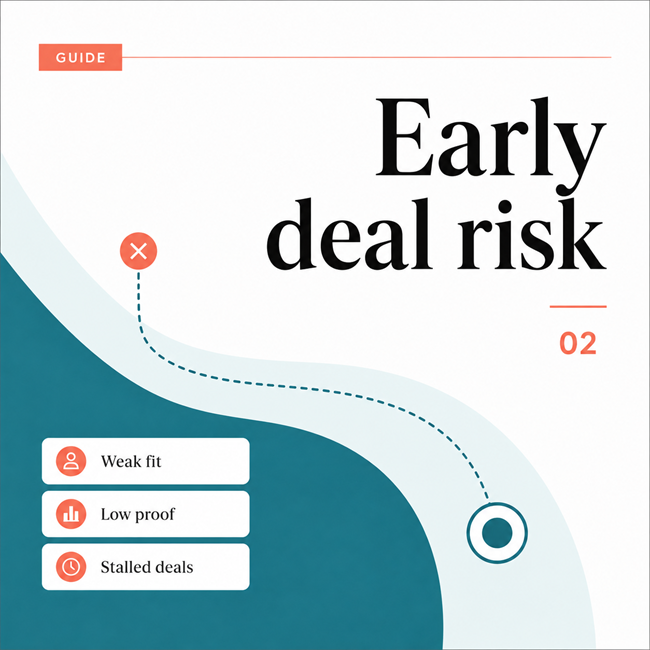
1. Weak-fit enquiries
People enquire, but the fit, urgency or commercial need isn’t strong enough.
2. Slow deal movement
The buyer is interested, but not convinced enough to keep the decision moving.
3. Repeated objections
The same questions keep coming up because the earlier proof wasn’t strong enough.
4. Quiet lost deals
The buyer doesn’t always say no. They just stop replying, delay the decision or choose someone else.
Use the guide to review your own deal risk
Download the full guide and use the checklist to review your own B2B buyer journey.
It will help you spot where buyers may be losing confidence, where your proof is too thin, and where your sales process is being asked to fix problems that started earlier.
When to review
early deal risk
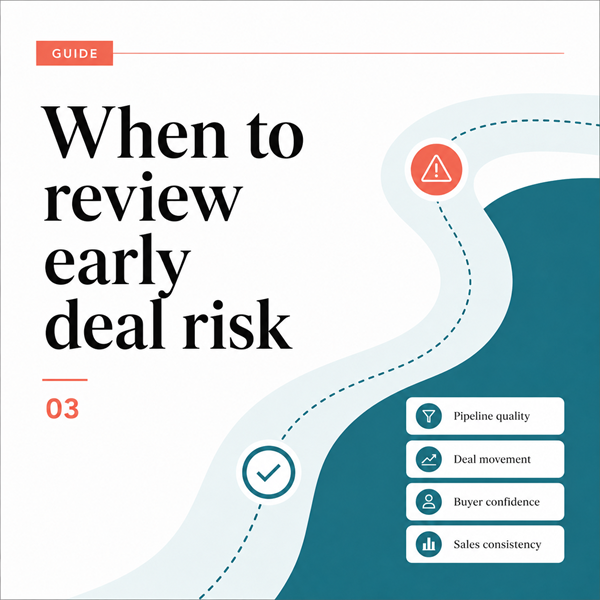
Review early deal risk when the pipeline looks active, but conversion stays weak.
Deals may stall after proposal. Buyers may keep asking basic comparison questions. Sales activity may be high, while revenue and forecast confidence remain inconsistent.
That usually points to a commercial system problem.
Positioning, proof, buyer enablement, sales messaging and follow-up all shape B2B buyer behaviour. When those pieces don’t work together, buyers feel uncertainty.
They may call it “not quite ready”.
You should treat it as deal risk.
SOME OF THE BUSINESSES WE’VE WORKED WITH
SUSTAINABLE
Find the hidden deal risk
The full guide shows where buyers form early opinions, how those judgement points affect pipeline quality, and what to fix before buyers quietly rule you out.